
Plant Encyclopedia

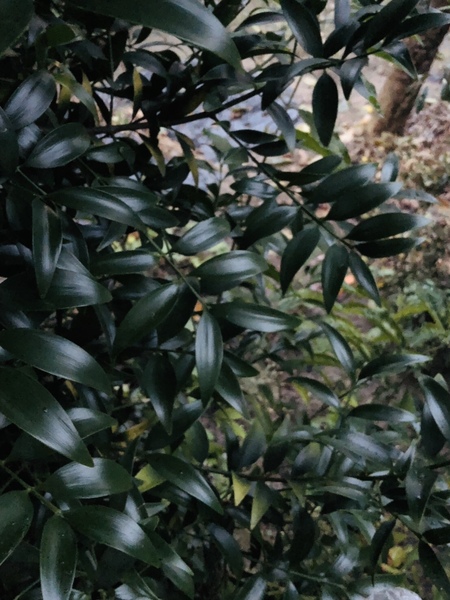
Nageia nagi (Asian bayberry)
Japanese name: ナギ (梛)
Scientific name: Nageia nagi
[Overview]
An evergreen coniferous tree 20 m tall with a trunk diameter of 50–80 cm.
The bark peels off in scales.
The leaves are simple and opposite, ovate to oblong-lanceolate, 4–8 cm long and 1–3 cm wide, thick and glossy.
The leaves have many fine parallel veins.
The petiole is twisted 90 degrees relative to the branch.
It is dioecious.
Both male and female flowers are borne in the leaf axils of the previous year's branches; the male flowers are cylindrical and borne in clusters of several, and the female flowers are borne singly.
The seeds are spherical, 1–1.5 cm across, and are enclosed in a whitish-green covering formed by thickened, fleshy scales.
[History]
It is often planted at shrines as a sacred tree; the Nagi at Kumano Hayatama Shrine in Shingu, Wakayama, the Nagi forest in the precinct of Kasuga Shrine in Nara, and the northern-limit natural habitat in Ogori, Yamaguchi are known as national natural monuments.
Also, because the name evokes "nagi" (a calm sea), the leaves are used as charms for safe sea travel.
[Uses]
The yellowish-brown wood is dense and is used for furniture, utensils and the like.
[Cultivation]
Propagate from seed.
Remove the covering from the seeds and sow them immediately, or store them without letting them dry and sow in spring.
The suitable planting area is southern Kanto and further south.
It is a tree for warm regions, and especially while young its cold resistance is weak.
It is not particular about soil as long as the site is sunny and well drained.
It tolerates shade.
For potted plants and plants within 2 years of planting in the ground, water thoroughly when the soil surface dries; for plants established in the ground, rainfall is sufficient.
For fertilizer in winter, dig holes around the plant and apply organic fertilizer.
There are no particular pests or diseases.
[Notes]
The other Japanese name derives from the leaves being strong and hard to tear.
Details
Japanese: ナギ(梛)、ベンケイナカセ(弁慶泣かせ)、センニンリキ(千人力)
Translated from our Japanese encyclopedia. If anything differs, the Japanese page is correct.