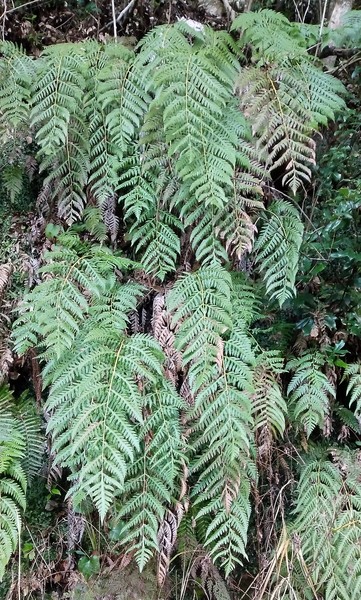
Japanese name: コモチシダ(子持羊歯) Scientific name:Woodwardia orientalis
[Overview]
An evergreen terrestrial fern found on cliffs near the coast and in mountain forests.
It has a thick, short rhizome densely covered with scales.
The scales are lanceolate, membranous, and slightly glossy brown.
The leaves are tufted from the rhizome, 0.3–2 m long, leathery and twice pinnately divided; the pinnae are ovate-lanceolate to triangular-lanceolate.
The segments are pointed at the tip, those on the front side of the pinna axis are longer than those on the back side, and the margins are toothed.
The veins form a network of 1–2 rows along the pinna axis and the main veins of the segments.
Many bulbils form on the upper surface of the leaves.
The sori are slender and attached along the main veins of the segments.
The petiole is thick, 30–60 cm long, and densely covered with scales at the base.
[Notes]
The Japanese name comes from the fact that bulbils form on the leaf surface and produce young plantlets.