
Plant Encyclopedia

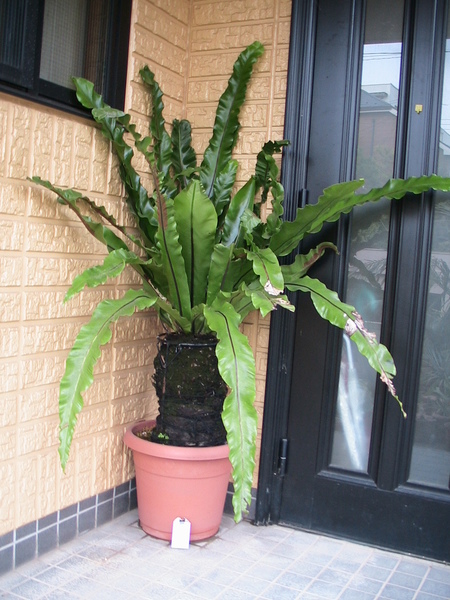
Asplenium nidus (bird's nest fern, "Shimaotaniwatari")
Japanese name: シマオオタニワタリ (島大谷渡)
Scientific name: Asplenium nidus
[Overview]
An evergreen fern that grows attached to trees.
It has a short, mass-like rhizome and produces many leaves radiating outward.
The leaves are simple, sword-like and lanceolate, 1 m or more long and 12–30 cm wide.
The leaf tip is pointed.
The midrib (main vein) on the underside of the leaf is flat.
The sori are arranged in lines along the lateral veins on the underside of the leaf, usually extending no more than half the width from the main vein to the leaf margin.
The petiole is 2–5 cm long and brown, and its base bears many scales 2 cm long and 3 mm wide.
The scales are lanceolate to linear and brown, with wavy margins and hair-like projections.
The plant forms a cup shape; in its native habitat fallen leaves and the like collect in the cup, and other plants grow attached there.
[Cultivation]
Propagate by spores or division, but this is difficult for ordinary households.
It prefers humus-rich, well-drained soil.
Poor drainage causes root rot.
It may also be mounted on a tree fern board or similar.
It prefers bright shade and should be kept out of direct sunlight.
It tolerates shade, but long periods of weak light make it leggy, so in winter keep it indoors where it receives light through glass.
It is not cold-hardy, so in winter keep it indoors where a temperature of 5–7 °C or higher can be maintained.
From spring to autumn, water when the soil surface dries, so that the water covers the whole plant.
Keep it on the dry side in winter, but mist the leaves, mainly the center where new shoots emerge.
During the growing season from spring to autumn, apply slow-release fertilizer once every 2 months or liquid fertilizer once every 2 weeks.
Remove lower leaves early when they wither.
Pests and diseases include anthracnose, soft rot, scale insects, spider mites, slugs and snails.
[Notes]
Otaniwatari is distinguished by its sori extending over two thirds or more of the width from the main vein to the leaf margin.
Ryukyu-torinosu-shida is distinguished by the markedly raised midrib on the underside of the leaf.
Details
Japanese: シマオオタニワタリ(島大谷渡)
Translated from our Japanese encyclopedia. If anything differs, the Japanese page is correct.