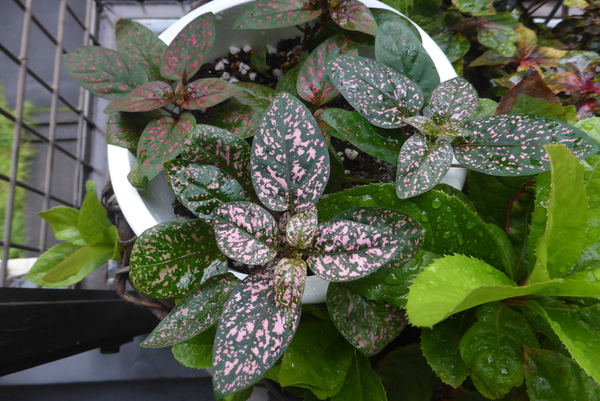
Japanese name: ヒポエステス フィロスタキア Scientific name:Hypoestes phyllostachya
[Overview]
An evergreen subshrub or perennial 1 m tall.
It branches well from the base and grows densely.
Leaves are simple and opposite, ovate to elliptical, 4–7 cm long, with pointed tips and entire margins.
The upper surface of the leaf is spotted all over with pink, red, white and other colors; on the underside the spots are very pale and often white.
The petiole is 2–4 cm long.
Flower stalks about 10 cm long extend from the leaf axils in the upper part of the stem, and each node bears one reddish purple flower.
The flowers are labiate and twisted 180 degrees so that top and bottom are reversed.
The apparent upper lip is shallowly 3-lobed, and the lower lip hangs down.
The fruit is a capsule.
[Cultivation]
Propagate by cuttings.
It prefers a well-drained soil.
Give it sun from autumn to spring, keep it in a warm place indoors in winter, and in midsummer bright shade is suitable.
From spring to autumn, water thoroughly when the soil surface dries; in winter, keep it on the dry side.
From spring to autumn, place slow-release fertilizer on the soil.
Pests and diseases include spider mites, scale insects, slugs and anthracnose.