
Plant Encyclopedia

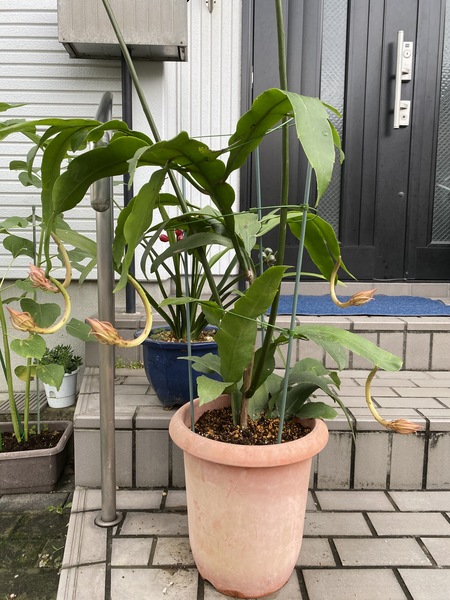
Epiphyllum oxypetalum (Dutchman's pipe cactus)
Japanese name: 月下美人
Scientific name: Epiphyllum oxypetalum
[Overview]
An epiphytic forest cactus that grows on trees.
It is a flowering cactus grown for its blooms.
The stems are flat, leaf-like cladodes with a woody base, growing to 3 m or more in length and producing many branches.
The margins of the cladodes are wavy, and the indentations bear very small areoles without spines.
Branches and flowers emerge from these indentations and from the stem tips.
Once the plant is well established and the cladodes reach about 2 m in length, it bears flowers.
The flowers are solitary, large, about 12 cm across and 20 cm long, and white, with many tepals and stamens.
The buds point downward, but the flowers face upward when they open.
The flowers open at night and usually wilt about 2 hours after opening, or at the latest before dawn.
The flowers have a strong fragrance.
It flowers several times during the flowering period.
The fruit is elliptical and reddish purple, and the white flesh contains many sesame-like black seeds.
[Uses]
The flowers and fruit are edible.
[Cultivation]
Propagate by cuttings.
It can be grown in open ground in places such as Okinawa, but in regions where the temperature falls to 8°C or below in winter, grow it in a pot and keep it indoors in winter.
It prefers a sunny place, and flowering is poor if the light is insufficient, but direct summer sun causes leaf scorch, so move it to partial shade in summer.
Plant it in well-drained soil; from spring to autumn, water when the soil surface dries, and in winter withhold water if the temperature falls below 10°C.
If kept dry, it tolerates temperatures down to nearly 0°C.
Overwatering causes root rot.
The stems lean as they grow soft and long, so staking makes them easier to manage.
From spring to autumn, apply a slow-release organic fertilizer rich in phosphorus and potassium, placed on the soil.
Pests and diseases include sooty mold, slugs and scale insects.
Details
Japanese: 月下美人、シロクジャク(白孔雀)
Translated from our Japanese encyclopedia. If anything differs, the Japanese page is correct.