
Plant Encyclopedia

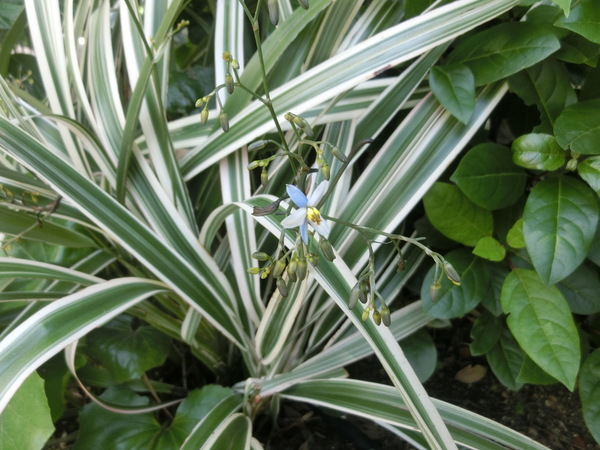
Dianella tasmanica (Tasman flax-lily)
Japanese name: ディアネラ タスマニカ
Scientific name: Dianella tasmanica
[Overview]
An evergreen perennial.
The rhizome is thick and jointed, and covered with old leaf sheaths.
The leaves gather at the base of the plant and are arranged alternately in two rows; they are linear, 80–100 cm long and 1.5–4 cm wide, with very fine serrations, leathery, thick and glossy.
The leaf bases fold in two into sheaths that overlap one another.
In the tropics it flowers all year round.
A flower stalk 0.5–2 m tall bears small leaves and, at its tip, a panicle with sparsely arranged flowers.
The flowers are blue and 6-petaled, 1.5–2 cm across, with petals that open flat and curve back slightly.
There are 6 stamens, with the tips of the filaments thickened.
The fruit is spherical to elliptical, about 1 cm across, ripening to bluish purple, and the seeds are black and glossy.
[Cultivation]
Propagate from seed or by division.
It can overwinter outdoors in frost-free areas south of the Kanto region; in cold regions the aboveground parts die back in winter, but if the roots do not freeze it sprouts again in spring.
It prefers a well-drained, well-ventilated site in sun to partial shade.
For potted plants, water thoroughly when the soil surface dries; for plants in the ground, rainfall is sufficient.
Established plants tolerate some dryness.
Fertilizing can be light; if basal fertilizer is applied, none is particularly needed, but for potted plants apply a small amount in spring or autumn, watching the condition of the plant.
There are no particular pests or diseases.
Details
Japanese: ディアネラ タスマニカ
Translated from our Japanese encyclopedia. If anything differs, the Japanese page is correct.