
Plant Encyclopedia

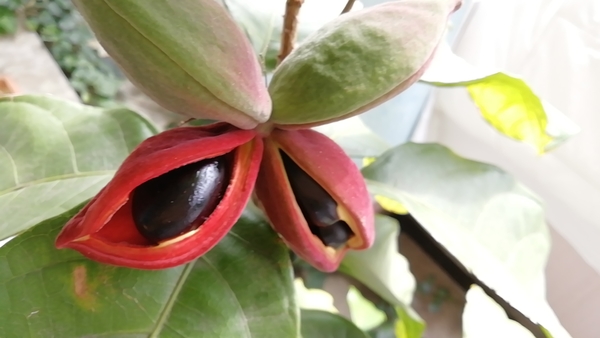
Sterculia monosperma (Chinese chestnut, "Pinponnoki")
Japanese name: ピンポンノキ
Scientific name: Sterculia monosperma
[Overview]
An evergreen tree about 10 m tall.
It may drop its leaves when exposed to cold.
The leaves are simple and alternate, elliptic, 8–25 cm long and 5–15 cm wide, with entire margins and a glossy upper surface.
The leaf veins are pinnate.
There are male and female flowers, both small and white; many male flowers and a few female flowers are borne in panicles about 20 cm long that arise from the leaf axils or branch tips.
The flowers have no petals; the conspicuous calyx is cream-colored and later turns reddish.
The calyx is 5-lobed and hairy on the outside; the calyx lobes are linear to lanceolate, curve inward, and are joined at the tips.
The flowers are fragrant.
The fruit is an oblong follicle about 5 cm long and 2–3 cm wide, pointed at the end like a beak; it ripens red and splits open, releasing 1–4 seeds.
The seeds are blackish brown and elliptic, about 1.5 cm across.
[Uses]
When heated, the seeds taste like chestnuts and are eaten; they are also used medicinally.
The fibers of the bark are also useful.
[Cultivation]
Propagate from seed or by cuttings.
It prefers a sunny, well-drained soil.
It tolerates about partial shade.
In winter, bring it indoors to a sunny, warm place.
From spring to autumn, water thoroughly when the soil surface dries; in winter, keep it on the dry side.
From spring to autumn, apply slow-release fertilizer placed on the soil.
Pests and diseases include scale insects and spider mites.
[Notes]
The name comes from the pronunciation of its Chinese name.
Details
Japanese: ピンポンノキ、ピンポンツリー
Translated from our Japanese encyclopedia. If anything differs, the Japanese page is correct.