
Plant Encyclopedia

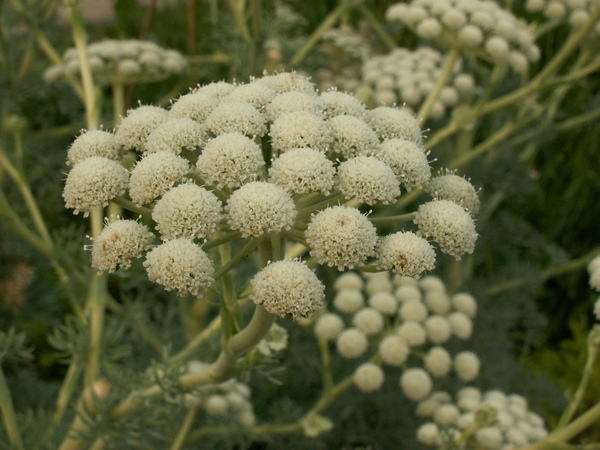
Seseli gummiferum (moon carrot)
Japanese name: セセリ グミフェルム
Scientific name: Seseli gummiferum
[Overview]
A biennial or short-lived perennial 60–90 cm tall.
In its native habitat it grows on limestone cliffs in mountains at an elevation of about 1,000 m.
It has a rhizome.
The whole plant is tinged with grayish green.
It does not flower until the plant has grown large; in the first year it grows as a rosette about 30–45 cm in both height and diameter.
From the second year onward it sends up thick, sturdy stems.
The leaves are 2–3 times pinnately divided and thick.
At the stem tips it bears large compound umbels up to 15 cm across, with 20–60 flower axes extending radially and carrying many small 5-petaled flowers; each umbel becomes spherical as flowering progresses.
The flower color is at first tinged with pink and later becomes white.
The involucral bracts and involucel bracts of the umbels are either absent or few.
The fruit is a schizocarp.
[Cultivation]
Propagate from seed.
It prefers well-drained soil.
It prefers sun but tolerates partial shade.
It dislikes heat and humidity, so in warm regions plant it where it is protected from strong summer direct sun and western sun, and grow it somewhat on the dry side.
It tolerates dryness, so rainfall is sufficient unless sunny weather continues in summer and the soil dries out.
Fertilizer is not particularly necessary if a base fertilizer is applied.
If you do not intend to collect seed, cutting the flower stalks off at the base after flowering makes its perennial nature more likely to appear.
There are no particular pests or diseases.
Details
Japanese: セセリ グミフェルム、ムーンキャロット
Translated from our Japanese encyclopedia. If anything differs, the Japanese page is correct.