
Plant Encyclopedia

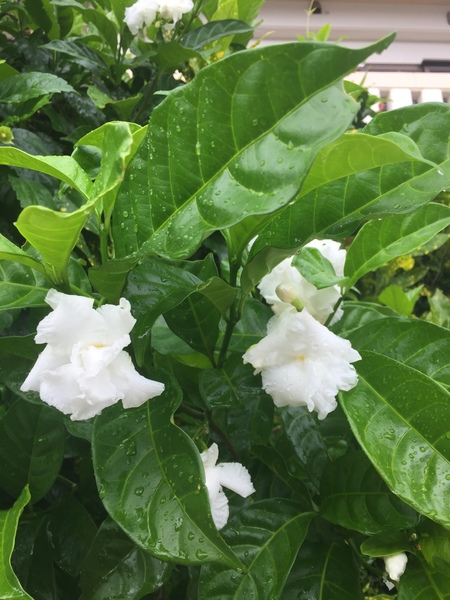
Tabernaemontana divaricata (pinwheel flower, "San'yuka")
Japanese name: サンユウカ
Scientific name: Tabernaemontana divaricata
[Overview]
An evergreen shrub or small tree 0.5–5 m tall.
White milky sap exudes when the stems or leaves are damaged.
It branches well.
The leaves are simple and opposite, ovate to elliptic, 3–18 cm long and 1–6 cm wide, glossy, with entire margins.
Dichotomously branching cymes arise from the branch tips or leaf axils and bear several flowers.
The flowers are white, about 3–4 cm across; the corolla is 5-lobed, twisted in one direction, and fragrant at night.
The corolla tube is about 1.5–2.7 cm long.
The buds are ovate with a pointed tip.
The fruit is an elliptic follicle 2–7 cm long and 0.6–1.5 cm wide, borne in pairs; the seeds are enclosed in a fleshy red aril.
[Uses]
Although poisonous, the root is used medicinally, and the flowers, leaves, milky sap and wood are used as folk remedies.
The aril serves as a red dye.
The wood is used for incense and perfume.
[Cultivation]
Propagate mainly by cuttings.
It prefers sun to partial shade and well-drained, moist, acidic soil.
In winter, bring it indoors to a sunny place.
From spring to autumn, water thoroughly when the soil surface dries; in winter, keep it on the dry side.
From spring to autumn, apply slow-release fertilizer placed on the soil.
Prune only to tidy the shape; because the flowers bloom on newly grown branches, prune right after flowering or before new buds emerge.
Pests include scale insects and thrips.
Details
Japanese: サンユウカ
Translated from our Japanese encyclopedia. If anything differs, the Japanese page is correct.