
Plant Encyclopedia

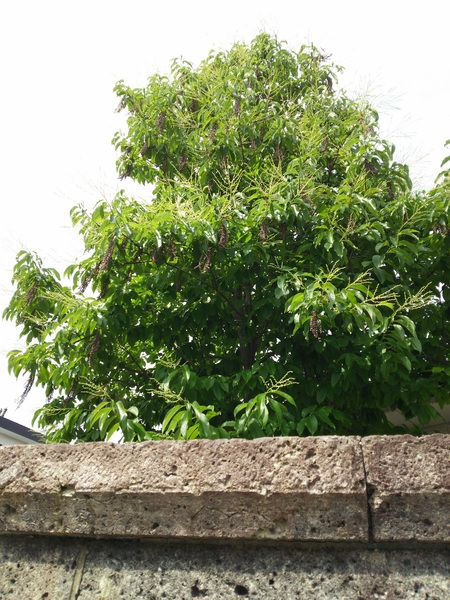
Oxydendrum arboreum (sourwood)
Japanese name: オキシデンドルム アルボレウム
Scientific name: Oxydendrum arboreum
[Overview]
A deciduous large shrub or tree 6–12 m tall; in its native habitat some reportedly reach 30 m in height and 0.6 m in trunk diameter.
It has a neat, elliptical crown.
The branches extend horizontally and often curve, giving an elegant impression.
The bark is gray-brown and thick, deeply split into a tortoiseshell-like to scaly pattern.
The leaves are simple and alternate, ovate to oblong-lanceolate, 8–20 cm long and 4–9 cm wide, finely toothed, and shaped like the leaves of Momo.
The leaves are glossy.
In autumn the leaves turn a vivid red tinged with purple.
The leaves are sour, which is the origin of the English name.
Panicles 15–25 cm long hang from the branch tips; the branches of the inflorescence curve gently, bearing many small flowers that face downward.
The flowers are white and urn-shaped, 0.6–0.9 cm long, shallowly 5-lobed at the tip, and resemble the flowers of Asebi.
There are 10 stamens.
The flowers are fragrant.
The fruit is a capsule and is borne upward.
[Uses]
In its native range it is used as a honey source tree.
[Cultivation]
Propagate from seed or by cuttings (softwood cuttings).
It prefers acidic soil.
It prefers fertile, well-drained soil in a sunny place; in poor light, flowering and autumn color are poor.
Avoid places that get strong afternoon sun or that become dry.
It grows slowly, but is hardy and easy to grow.
For plants in the ground, rainfall is sufficient unless summer brings a long spell of sunny weather and the soil becomes dry.
Apply organic fertilizer around the plant in winter.
There are no particular pests or diseases.
[Notes]
There is another tree with the same name "Suzuran-no-ki", Zenobia pulverulenta.
Details
Japanese: オキシデンドルム アルボレウム、スズランノキ(鈴蘭の木)
Translated from our Japanese encyclopedia. If anything differs, the Japanese page is correct.