
Plant Encyclopedia

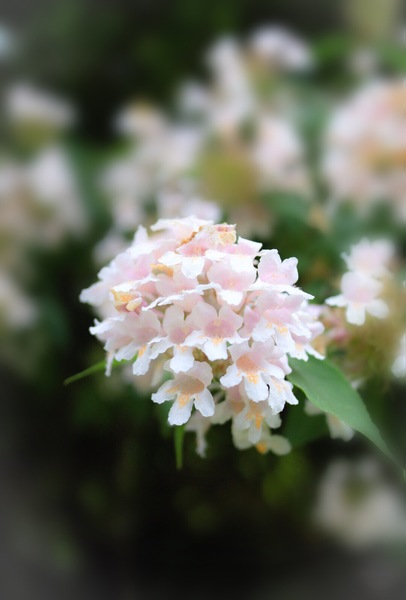
Kolkwitzia amabilis (beauty bush, "Shokiutsugi")
Japanese name: ショウキウツギ (鍾馗空木)
Scientific name: Kolkwitzia amabilis
[Overview]
A deciduous shrub 2–3 m tall.
The bark is pale brown and peels off in thin layers.
The trunks grow in clumps, extend in arches, and branch well to form dense growth.
The young twigs are at first densely hairy.
The leaves are simple and opposite, elliptic to ovate, 3–8 cm long and 1.5–2.5 cm wide, with a pointed tip; the margin has sparse low teeth or is entire.
The underside of the leaf is covered with soft hairs.
Corymbs are produced at the branch tips.
The flowers are borne in pairs, with the ovaries fused together.
The flowers are bell-shaped to funnel-shaped, 1.5–2.5 cm long, and the tip is divided into 5 lobes in a two-lipped form.
The corolla is deep pink on the outside and pale pink on the inside, with an orange net-like pattern in the throat.
There are 5 sepals, which spread out like a shuttlecock.
The flower stalk and ovary are densely hairy.
The fruit is an achene formed of 2 fused fruits, wrapped in long hairs, with the sepals remaining.
[Cultivation]
Propagate from seed, cuttings, or layering.
It prefers a well-drained site in sun to partial shade.
It is easy to grow.
Rainfall is sufficient for watering.
If basal fertilizer is applied, no further fertilizing is particularly necessary, but depending on growth, organic fertilizer may be applied in winter.
It grows quickly and becomes thicket-like if left alone, so thin out overly long shoots and crowded branches during the leafless season.
There are no particular pests or diseases.
Details
Japanese: ショウキウツギ(鍾馗空木)
Translated from our Japanese encyclopedia. If anything differs, the Japanese page is correct.