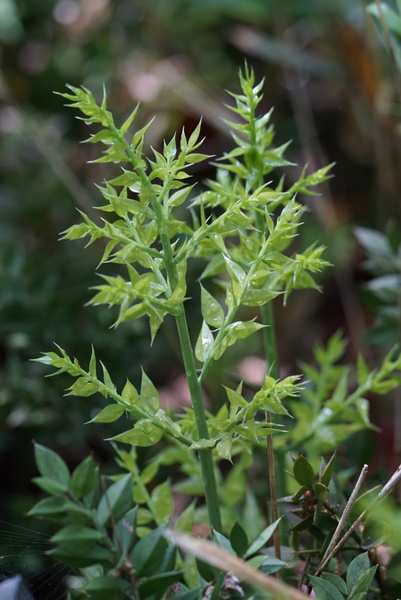
Japanese name: ナギイカダ(梛筏) Scientific name:Ruscus aculeatus
[Overview]
An evergreen shrub 60–90 cm tall.
It has underground rhizomes and sends up stems from the axils of scales.
The stems are green, marked with many vertical lines, and branch often.
The leaves are alternate but are reduced to small scales; what look like leaves are cladodes, which are modified branches.
The cladodes are ovate, 1–4 cm long, dark green, thick and hard, with needle-like pointed tips.
The plants are mostly dioecious, but some plants bear bisexual flowers, and male plants may bear imperfect male flowers.
A short raceme arises from the scale-like bract on the midvein on the upper side of the cladode and bears 1–2 flowers.
The flowers are greenish white with 6 petals, about 0.2 cm across.
The 3 stamens are fused together to form a purple staminal tube.
The fruit is a spherical berry about 1 cm across, ripening to red.
[Cultivation]
Propagate from seed or by division.
When growing from seed, take the seeds out of fully ripe fruits and sow them immediately.
It prefers sun to partial shade and soil that is well drained and retains moisture.
It tolerates deep shade quite well and is also resistant to dryness.
The spines at the leaf tips are sharp, so take care when choosing a planting site and when pruning.
For potted plants, water thoroughly when the soil surface dries; for plants in the ground, rainfall is sufficient.
Apply organic fertilizer around the plant as fertilizer in winter.
Cut dead branches off at the base.
There are no particular pests or diseases.