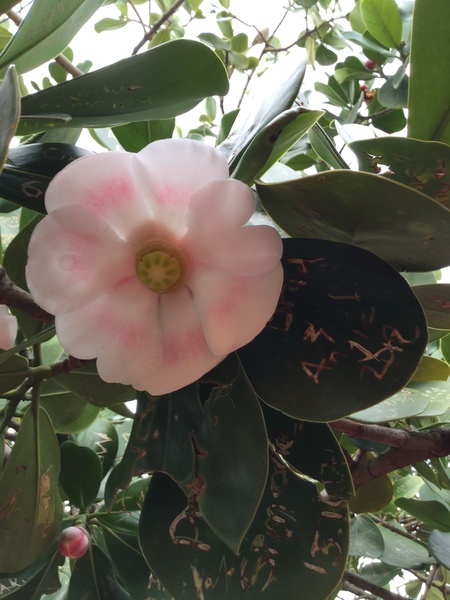
Japanese name: クルシア ロセア Scientific name:Clusia rosea
[Overview]
An evergreen small tree up to 6 m tall.
The branches tend to droop, and it produces aerial roots that cling to other trees and rocks.
Leaves are simple and opposite, obovate to ovate, 10–20 cm long, leathery and glossy.
The leaf margins are entire.
If a leaf is scratched, the mark remains, so you can write on it.
The branch tips bear pink to white flowers 5 cm across with 5–6 petals.
There are 5–6 sepals, the same color as the petals.
The style is green.
The fruit is a fleshy capsule, pale green.
The seeds are dispersed by birds and small animals, but in the wild they often germinate and grow as epiphytes in trees, and as they grow the aerial roots may cover the host tree and kill it.
[Cultivation]
Propagate from seed, by cuttings, or by air layering.
For layering, cut the layer off with the aerial roots still attached.
It is safest to keep it at 5°C or higher over winter.
It prefers a hot, humid environment and sunny, well-drained soil.
From spring to autumn, water thoroughly when the soil surface dries; in winter, keep it on the dry side.
Also mist the leaves with water throughout the year.
From spring to autumn, give liquid fertilizer once every 2 weeks, or place slow-release solid fertilizer on the soil once every 2 months.
There are no particular pests or diseases.