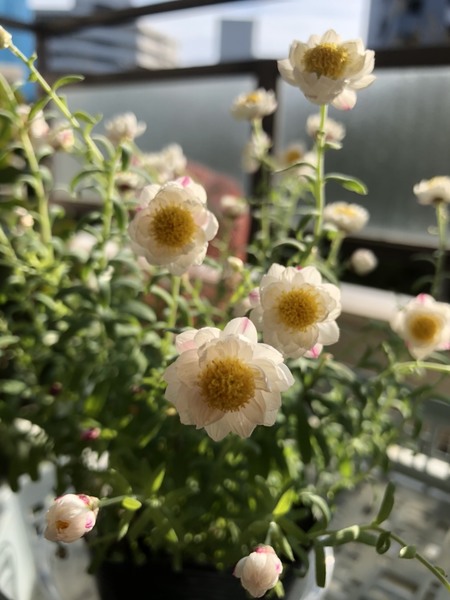
Japanese name: ハナカンザシ(花簪) Scientific name:Rhodanthe chlorocephala subsp. rosea
[Overview]
An annual 20–70 cm tall.
The whole plant is tinged with grayish green.
The stem branches from the base, is erect and hairless.
Leaves are simple and alternate, spatulate-lanceolate to linear, about 1–6 cm long, with entire margins.
A solitary flower head 2.5–6 cm across forms at the stem tip; many involucral bracts that look like petals surround the head, so it looks like a double flower.
The bracts are deep pink to white and papery in texture.
The central tubular florets are yellow.
The flowers close in cloudy weather and at night.
The fruit is an achene.
[Cultivation]
Propagate from seed.
It prefers a sunny, well-drained, well-ventilated, dry place.
It dislikes acidic soil and suits calcareous sandy soil.
Take care not to overwater; for potted plants, after the soil has dried, water thoroughly at the base of the plant without wetting the flowers, and for plants in the ground, rainfall is sufficient.
If base fertilizer is applied, no further fertilizer is particularly needed.
Pests and diseases include gray mold, aphids and slugs.