
Plant Encyclopedia

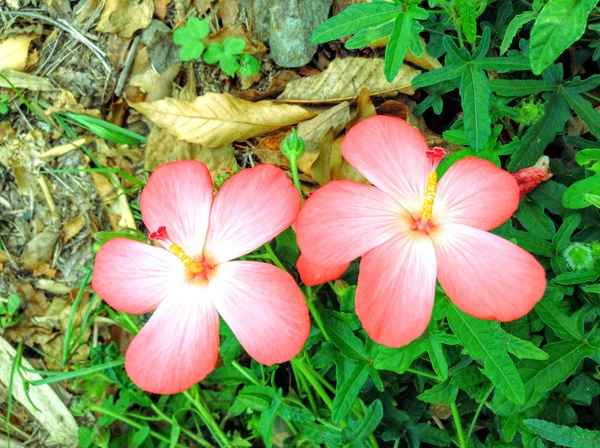
Abelmoschus moschatus subsp. tuberosus ("Akabanawata")
Japanese name: アカバナワタ (赤花綿)
Scientific name: Abelmoschus moschatus subsp. tuberosus
[Overview]
A perennial 40–80 cm tall, treated as an annual in Japan.
It has tubers underground.
The stem branches well and is covered with long hairs.
The leaves are alternate, about 4–12 cm across, deeply palmately divided into 5 lobes, with long hairs on the veins of the underside.
The lobes may be further divided, and the margins are toothed.
The petiole has long hairs.
Flowers about 10–14 cm across are borne in the leaf axils in the upper part of the stem.
The flowers resemble hibiscus; they are red with a white to cream center.
The staminal column bends in the middle.
The stigma is red.
The flowers wilt in one day.
The flower stalk has long hairs.
The fruit is a capsule, long-ovoid, 5 cm long, with 5 ridges and covered with hairs.
[Cultivation]
Propagate from seed.
It is easy to grow, and in warm regions it can overwinter if cut back close to the ground and protected from the cold, or moved to a warm place indoors.
It prefers a sunny, well-drained site.
For potted plants, water thoroughly when the soil surface dries; for plants in the ground, rainfall is sufficient.
If basal fertilizer is applied, no further fertilizing is particularly necessary.
There are no particular pests or diseases.
Details
Translated from our Japanese encyclopedia. If anything differs, the Japanese page is correct.