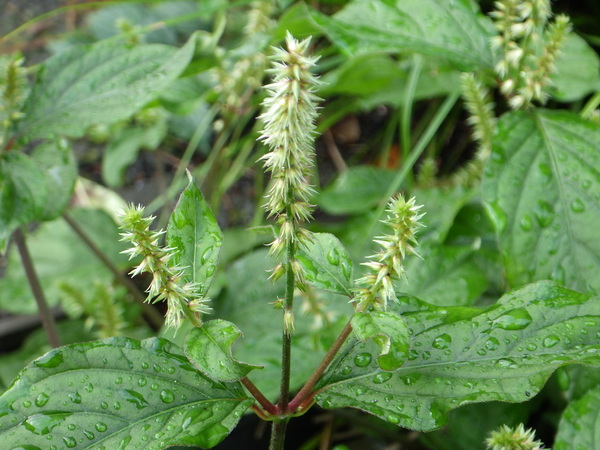
Achyranthes bidentata var. fauriei("Hinatainokozuchi")
Japanese name: ヒナタイノコヅチ(日向豕槌、日向牛膝) Scientific name:Achyranthes bidentata var. fauriei
[Overview]
A perennial 50–100 cm tall, found in sunny places such as urban areas.
The stems and leaves are covered with many hairs.
The stem has 4 ridges, spreads sparse branches, and has swollen nodes.
The leaves are simple and opposite, oblong, thick, and entire.
The leaf margins are often wavy.
Both surfaces of the leaves are very hairy, and the undersides of young leaves in particular look whitish.
Spike-like inflorescences at the branch tips densely bear small green flowers.
After flowering, the flowers point downward and sit tightly against the axis.
The flowers have triangular, spiny bracts, and the appendages at the base are small, about 0.3 mm.
The fruit is a utricle, and it is carried by animals and clothing, clinging by means of the spiny bracts.