EVERGREEN

Plant Encyclopedia

Physocarpus opulifolius

Physocarpus opulifolius (common ninebark, "Amerikatemarishimotsuke")

Japanese name: アメリカテマリシモツケ
Scientific name: Physocarpus opulifolius

Physocarpus opulifolius

[Overview]
A deciduous shrub 1–3 m tall.
The bark peels off in thin layers.
It spreads by sending out suckers.
It branches well, and the branches extend in arches to form a rounded shape.
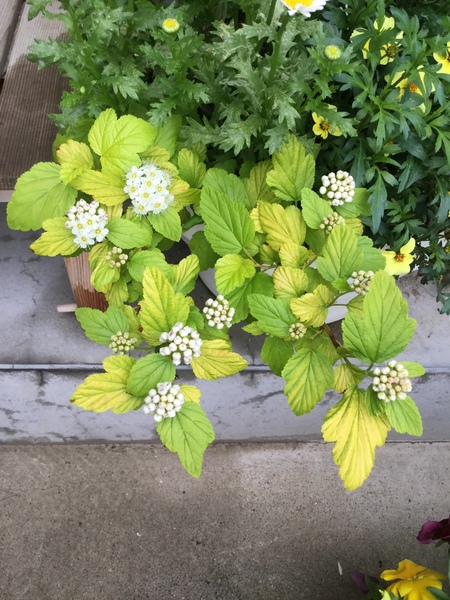
The leaves are alternate, broadly ovate, about 3–12 cm long, usually 3–5-lobed, with irregular serrations on the margin.
The petiole is 0.8–2.4 cm long.
The leaves turn red in autumn.
Corymbs about 5–6.5 cm across at the branch tips bear many pale pink or white flowers 5–6 mm across with 5 petals.
The flowers have many long, protruding stamens.
The fruit is a follicle.

[Cultivation]
Propagate from seed, cuttings, or suckers.
It prefers sun to partial shade and well-drained, fertile, acidic soil.
For potted plants, water thoroughly when the soil surface dries; for plants in the ground, rainfall is sufficient unless summer brings a long spell of sunny weather and the soil becomes severely dry.
Apply organic fertilizer in winter and after flowering as a thank-you fertilizer.
There are no particular pests or diseases.

Details

Names
English: common ninebark, Eastern ninebark, Atlantic ninebark
Japanese: アメリカテマリシモツケ、アメリカシモツケ
Life form
Shrub
Evergreen / deciduous
Deciduous
Leaf type
Broadleaf
Habit
Terrestrial
Planting (or sowing) season
March, April, October, November
Flowering season
May, June
Fruiting season
August, September, October
Distribution or origin
Eastern North America
Growth form
Branching
Height
1000–3000 mm
Leaf shape
Simple leaf (unlobed), Lobed leaf
Leaf arrangement
Alternate
Leaf margin
Serrate
Inflorescence
Corymb
Number of petals
5
Flower color
Pink, White
Flower diameter
5–6
Leaf color
Green
Availability of seeds and plants
Low
Form sold
Seedlings
Propagation
Seed, Cuttings, Suckers
Sun exposure
Full sun, Partial shade
Water needs
Moderate
Soil needs
Required
Soil acidity
Neutral, Acidic
Tolerance
Cold tolerance, Heat tolerance
Suitable uses
Potted plant, Flower bed, Parks and gardens, Container
Hardiness zone
2a
Japan Flower Trade Code
58375

Translated from our Japanese encyclopedia. If anything differs, the Japanese page is correct.

Sponsored