
Plant Encyclopedia

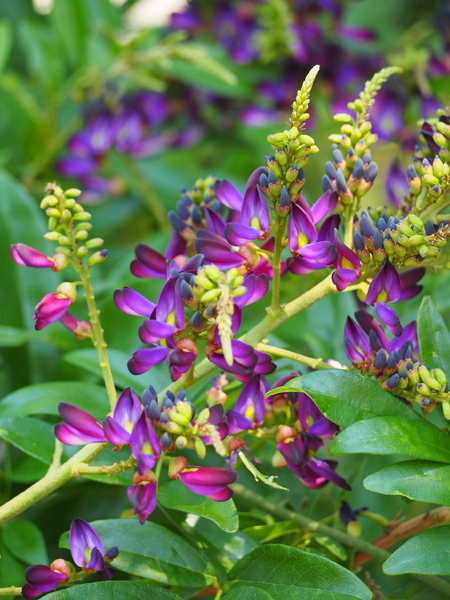
Callerya reticulata (evergreen wisteria, "Murasakinatsufuji")
Japanese name: ムラサキナツフジ (紫夏藤)
Scientific name: Callerya reticulata
[Overview]
An evergreen woody climber.
The vines are thick, much branched, and grow to about 10 m.
The leaves are alternate and odd-pinnately compound, consisting of 5–9 leaflets.
The leaflets are ovate to lanceolate, 3–9 cm long and 1.5–5 cm wide, hairless, somewhat thick and glossy, with entire margins.
At the stem tips, erect pseudoracemes 15–20 cm long and 20 cm wide bear many flowers densely.
The flowers are reddish purple to dark purple pea-type flowers, with a yellow marking on the standard petal.
The fruit is a flat, oblong pod 15 cm long and 1–1.5 cm wide, which does not split open even when ripe.
Each pod contains 3–6 flat, oblong seeds.
[Uses]
The stems are used medicinally.
[Cultivation]
Propagate by cuttings or grafting.
It can overwinter outdoors in regions without frost.
It prefers a sunny, well-ventilated, well-drained place, but potted plants are better moved to partial shade in summer.
Protect it from frost and cold wind in winter.
For potted plants, water thoroughly when the soil surface dries; for plants in the ground, rainfall is sufficient.
For plants in the ground, no fertilizer is particularly necessary; for potted plants, apply slow-release fertilizer placed on the soil from spring to autumn.
There are no particular pests or diseases.
Details
Japanese: ムラサキナツフジ(紫夏藤)、サッコウフジ(醋甲藤)、サツマサッコウフジ(薩摩醋甲藤)
Translated from our Japanese encyclopedia. If anything differs, the Japanese page is correct.