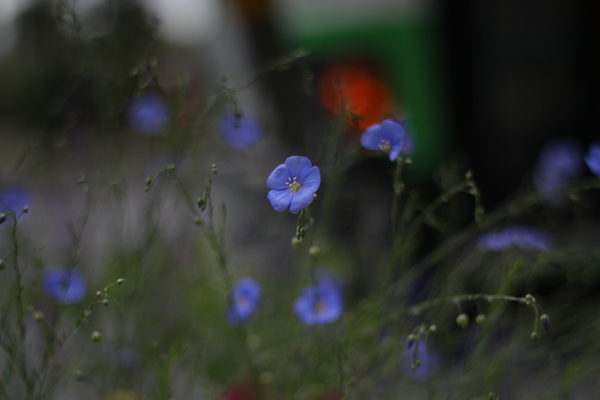
Japanese name: アマ(亜麻) Scientific name:Linum usitatissimum
[Overview]
An annual up to 120 cm tall.
The stem is slender and branches in the upper part.
The leaves are simple and alternate, linear to narrowly lanceolate, 2–4 cm long and about 0.3 cm wide, with entire margins.
Panicles at the stem tips bear blue 5-petaled flowers 1.5–2.5 cm across.
White-flowered plants also exist.
The fruit is a capsule.
[History]
It was introduced in the Meiji era as an ornamental, and plants that have escaped into the wild are sometimes seen.
[Uses]
The seed oil (linseed oil) is used medicinally and as food, and the fiber obtained from the stems is used for textiles and other products.
[Cultivation]
Propagate from seed.
It prefers a sunny, well-drained site.
It prefers a rather dry environment, so rainfall is sufficient.
If basal fertilizer is applied, no further fertilizer is particularly needed; too much fertilizer can make it leggy and cause it to fall over.
There are no particular pests or diseases.