
Plant Encyclopedia

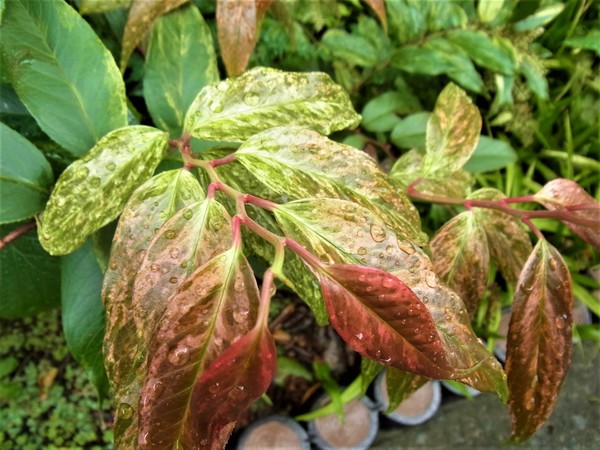
Leucothoe fontanesiana (highland doghobble, "Seiyoiwananten")
Japanese name: セイヨウイワナンテン (西洋岩南天)
Scientific name: Leucothoe fontanesiana
[Overview]
An evergreen shrub 1–2 m in both height and width.
The branches extend in an arch and branch well.
The leaves are simple and alternate, elliptic-lanceolate, 6–16 cm long, thick and glossy.
The leaf margins have fine tooth-like serrations and bristles.
Racemes 7–8 cm long at the branch tips and in the leaf axils bear many white, urn-shaped flowers.
The corolla tip is shallowly 5-lobed, and the lobes curve back.
There are 10 stamens.
The fruit is a capsule.
[Cultivation]
Propagate by cuttings or division.
It prefers fertile, acidic soil that is well drained and moderately moist.
Avoid dry sites, or prevent the base of the plant from drying out by mulching or similar means.
From spring to autumn, it is best placed in partial shade out of the western sun and direct summer sunlight; from autumn to spring, place it in a sunny spot protected from cold wind. In the ground, a place in the shade of deciduous trees is good.
For potted plants, from autumn to spring water thoroughly when the soil surface dries; in midsummer, water twice a day, in the cool morning and evening, so that the water also reaches the leaves.
For plants in the ground, rainfall is sufficient except in summer; in summer, water in the cool morning or evening so that the water also reaches the leaves, and in winter, if dry weather continues, water in the morning on a warm day.
As fertilizer after flowering, apply organic fertilizer or a slow-release chemical fertilizer around the plant.
There are no particular pests or diseases.
Details
Japanese: セイヨウイワナンテン(西洋岩南天)
Translated from our Japanese encyclopedia. If anything differs, the Japanese page is correct.