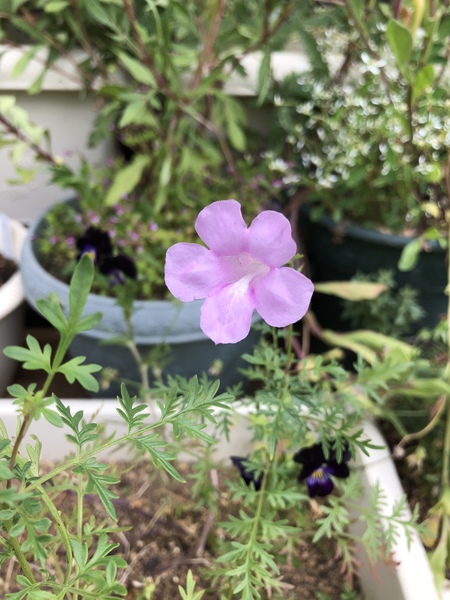
Japanese name: ハナゴマ Scientific name:Incarvillea sinensis
[Overview]
An annual or perennial about 80 cm tall.
The root is thick, woody and a taproot.
The leaves are alternate, about 20 cm long and finely pinnately divided.
Rose-pink flowers are borne on flower stalks extending from the leaf axils.
The flowers are funnel-shaped, about 4 cm long and 2.5 cm across, with 5 lobes at the tip.
The fruit is a capsule.
[Cultivation]
Propagate from seed, by division, or by cuttings.
In regions with frost, protection from frost and cold is necessary.
It prefers a well-drained, moderately moist, fertile soil.
In summer, do not let it become hot and humid.
Place potted plants in the sun except in midsummer, and in midsummer and during long rainy spells move them to airy partial shade where they are sheltered from rain.
For plants in the ground, under deciduous trees is good.
Take care not to overwater; for potted plants, from spring to autumn water thoroughly when the soil surface dries, and keep it on the dry side in winter.
For plants in the ground, rainfall is sufficient.
Apply basal fertilizer, and give slow-release fertilizer or liquid fertilizer in spring and autumn.
There are no particular pests or diseases.