
Plant Encyclopedia

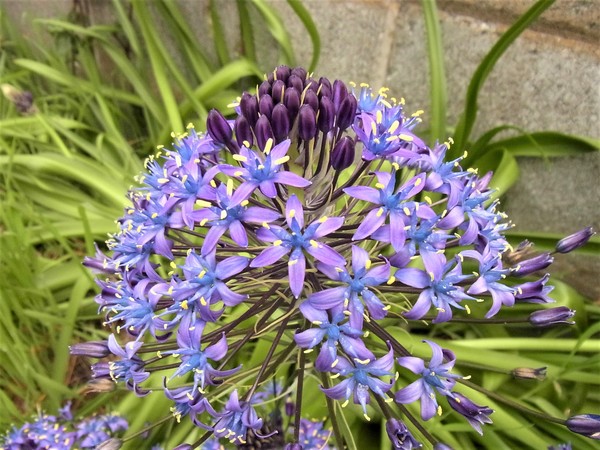
Scilla peruviana (Portuguese squill)
Japanese name: シラー ペルビアナ
Scientific name: Scilla peruviana
[Overview]
A perennial 20–50 cm tall with an underground bulb.
The bulb is pear-shaped, 6–8 cm across, with a membrane on the surface.
Many leaves arise from the base; they are broadly linear, about 15–30 cm long and 1.6–2 cm wide, with entire margins.
A thick flower stalk 20–50 cm tall rises from the center of the leaves and bears 40–100 flowers in a pyramid-shaped raceme.
The flowers are bluish purple, 6-petaled, 1–2 cm across, and open in a star shape.
Some are tinged with white or red.
The 6 thick stamens and yellow anthers are conspicuous.
The bracts are linear.
The fruit is a capsule.
In summer the leaves die back and the plant goes dormant.
[Uses]
The bulb is poisonous but is used medicinally.
[Cultivation]
Propagate from seed or by dividing the bulbs.
It prefers soil that is sunny, well drained, moisture-retentive and well aerated.
It tolerates some shade.
From sprouting until the leaves die back, water thoroughly when the soil surface dries.
Apply base fertilizer, and after flowering place slow-release fertilizer on the soil as a thank-you fertilizer.
It can be left in place for several years.
In that case, move potted plants to a cool, shaded place out of the rain once the leaves have died back and dormancy begins.
To lift the bulbs, dig them up when the leaves begin to die back, bury them in sand, peat moss or the like so they do not dry out completely, and store them in the same kind of place until planting in autumn.
After flowering, cut the flower stalk off at the base.
There are no particular pests or diseases.
Details
Japanese: シラー ペルビアナ、オオツルボ(大蔓穂)
Translated from our Japanese encyclopedia. If anything differs, the Japanese page is correct.