
Plant Encyclopedia

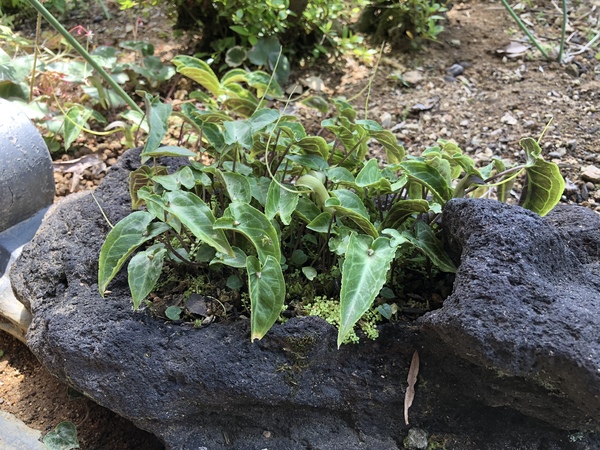
Pinellia cordata ("Nioihange")
Japanese name: ニオイハンゲ (匂半夏)
Scientific name: Pinellia cordata
[Overview]
A perennial 15–20 cm tall, growing in its native range in woods, along streams, and in moist pastures.
It has an underground corm 1–1.5 cm in diameter, flattened-spherical in shape.
1–3 simple leaves grow from the base; they are 4–25 cm long and 2–7.5 cm wide, oblong-cordate to arrowhead-shaped, with silvery white markings along the veins, and the undersides are tinged with purple.
The leaf margin is entire.
The petiole is 12–25 cm long and has purple markings.
Bulbils form at the base of the petiole and at the base of the leaf.
A spadix is borne at the tip of the flower stalk.
The appendage at the tip of the spadix is 6.5–20 cm long and extends in a winding, thread-like form.
The spadix is enclosed in a green to purple spathe.
The flowers are male and female, with no petals; the male flowers are borne in a group at the top of the spadix and the female flowers in a group at the base.
The spadix is fragrant.
The fruit is a berry.
[Cultivation]
Propagate from seed or bulbils; division of the corms is also possible.
When growing from seed, wash the fully ripe fruit to remove the pulp and sow immediately.
In cold regions, protect it from freezing.
It prefers moist, fertile soil in partial shade with good air circulation.
Strong sunlight damages the leaves, but too little sun makes the plant weak.
It dislikes dryness, so take care not to let it run short of water during the growing season, but excessive moisture in midsummer causes root rot.
Do not let the soil dry out completely even during dormancy.
It needs little fertilizer; place a small amount of organic fertilizer on the soil in spring and autumn.
Pests and diseases include soft rot, southern blight, scale insects, aphids and slugs.
Details
Translated from our Japanese encyclopedia. If anything differs, the Japanese page is correct.