
Plant Encyclopedia

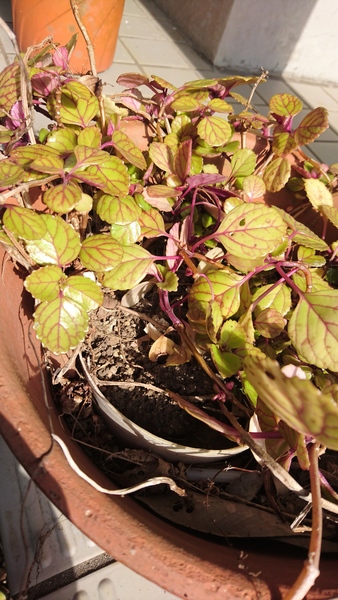
Plectranthus verticillatus (Swedish ivy)
Japanese name: プレクトランツス ウェルティキラツス
Scientific name: Plectranthus verticillatus
[Overview]
A perennial, but because it has weak cold tolerance it is treated mainly as an annual in Japan.
The stems creep along the ground.
Leaves are simple and opposite, almost circular, thick and glossy.
The leaves have orange glands and soft hairs.
The leaf margins are serrated.
The veins and petioles are often tinged with purple.
Many flowers are borne in spike-like inflorescences; they are pale lavender, lipped flowers.
The fruit is a schizocarp.
[Cultivation]
Propagate by division or by stem cuttings.
Cuttings can be taken at 15°C or above.
If brought indoors into a sunny place in winter, it can overwinter and be grown as a perennial.
It prefers fertile soil with good sunlight, drainage, water retention and aeration.
It prefers a well-ventilated place that does not dry out.
Direct summer sun fades the color of the leaves, so move it to partial shade in midsummer.
For potted plants, water thoroughly when the soil surface dries from spring to autumn, and keep on the dry side in winter; for plants in the ground, rainfall is sufficient.
However, if the soil dries out in midsummer, water in the morning or evening when the temperature is low.
Apply slow-release fertilizer as a base fertilizer, and also place slow-release fertilizer on the soil from spring to autumn.
Pests include armyworms, scale insects and spider mites.
Details
Japanese: プレクトランツス ウェルティキラツス、プレクトランサス ヌンムラリウス
Translated from our Japanese encyclopedia. If anything differs, the Japanese page is correct.