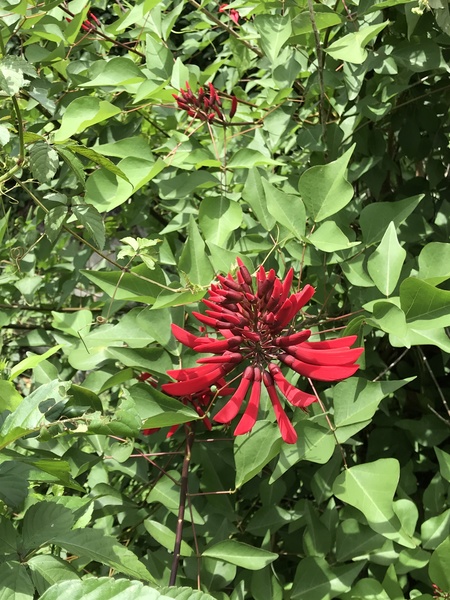
Japanese name: サンゴシトウ(珊瑚刺桐) Scientific name:Erythrina × bidwillii
[Overview]
A deciduous shrub growing to about 4 m tall.
There are thorns on the branches and on the veins on the undersides of the leaves.
The branches, leaf stalks and inflorescence axes are reddish purple.
The leaves are trifoliate, arranged alternately in a spiral.
The terminal leaflet is broadly ovate-rhombic, 8–11 cm long.
The leaf margin is entire.
Racemes 50–100 cm long arise at the branch tips.
The flowers are deep red and do not open much; the standard petal is oblong, about 5 cm long.
The standard petal is ovate and about 5 cm long.
It rarely sets fruit, but the pods and seeds resemble those of Erythrina crista-galli.
[History]
It was produced in Australia by crossing Erythrina herbacea with Erythrina crista-galli.
[Cultivation]
Propagate by cuttings, layering, or root cuttings.
It prefers a sunny, well-drained site.
Protect it from cold winter winds.
Rainfall is sufficient for watering.
Fertilizer is not particularly necessary.
Cut off the current year's branches shallowly, then cut back again just before buds break the following spring, so that the plant does not die back deeply.
There are no particular pests or diseases.