EVERGREEN

Plant Encyclopedia

Calendula

Calendula (genus)

Japanese name: カレンデュラ
Scientific name: Calendula

Calendula

[Overview]
An annual or perennial.
The stems and leaves are covered with many soft, somewhat sticky glandular hairs.
The leaves are simple and alternate, elliptic to lanceolate, with finely and shallowly serrated margins or entire margins.
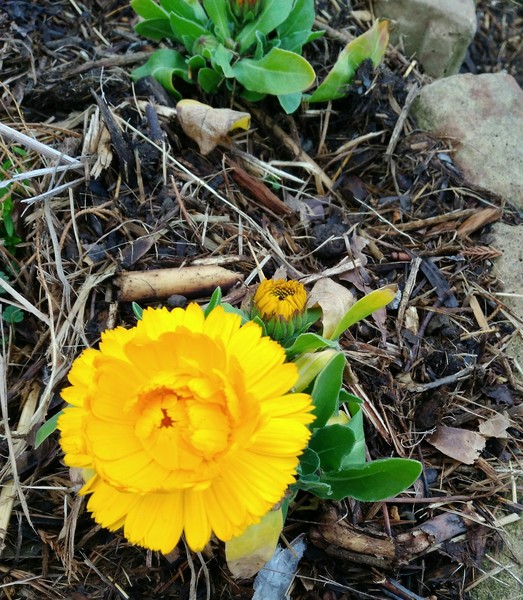
A single yellow to deep orange flower head is borne at the tip of the flower stalk.
The fruit is an achene without a pappus, strongly curved like the letter C.

[Cultivation]
Propagate from seed.
It is easy to grow.
It prefers a sunny, well-drained, moisture-retentive site.
Without enough sun, it flowers poorly.
It grows poorly in acidic soil and prefers slightly alkaline soil.
It is cold-hardy, but frost and snow damage the leaves, so frost protection may be provided.
Water thoroughly when the soil surface dries.
If base fertilizer is applied, little further fertilizer is needed.
Seed formation tires the plant, so remove flowers promptly after they bloom.
Pests and diseases include powdery mildew, cutworms and aphids.

Details

Names
Japanese: カレンデュラ
Life form
Annual, Perennial
Habit
Terrestrial
Planting (or sowing) season
September, October, November, February, March, April
Flowering season
October, November, December, January, February, March, April, May, June
Distribution or origin
Canary Islands to Persia
Leaf shape
Simple leaf (unlobed)
Leaf arrangement
Alternate
Leaf margin
Entire, Serrate
Inflorescence
Head
Flower color
Orange, Yellow
Leaf color
Green
Availability of seeds and plants
Low
Form sold
Seeds, Seedlings
Propagation
Seed
Sun exposure
Full sun
Water needs
Moderate
Soil needs
Required
Soil acidity
Alkaline
Tolerance
Cold tolerance
Suitable uses
Potted plant, Flower bed, Container
Diseases
Powdery mildew
Pests
Armyworms, Aphids
Japan Flower Trade Code
61694

Translated from our Japanese encyclopedia. If anything differs, the Japanese page is correct.

Sponsored