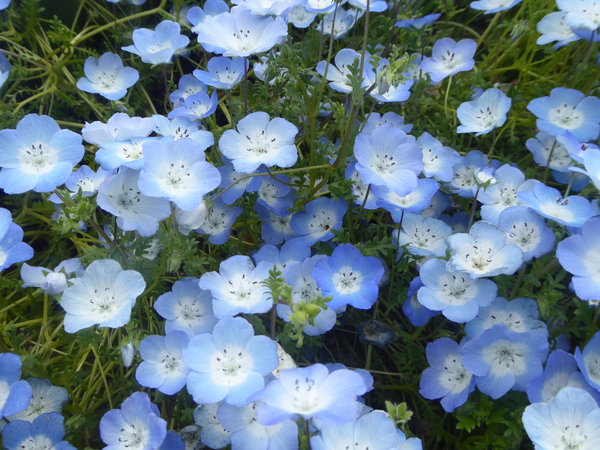
[Overview]
An annual with soft hairs on the stems and leaves.
It is low-growing, branches well, and spreads sideways.
Leaves are simple, alternate or opposite, and usually pinnately divided.
Flowers are solitary; the corolla is bell-shaped to wheel-shaped with 5 lobes, and flower colors include blue, white and purple, some with spots.
[Cultivation]
Propagate from seed.
It is an autumn-sown annual, but in cold regions it can also be sown in spring.
It dislikes transplanting, so sow directly or sow in pots and then plant out.
It is weak against rain and prefers a cool, dry place.
It prefers sunny, well-drained, fertile sandy soil rich in humus.
It is weak against heat and humidity.
Protect it from cold wind and frost, but too much protection from the cold will instead make it leggy.
For potted plants, water thoroughly when the soil surface dries; for plants in the ground, rainfall is sufficient.
Fertilizer is not particularly necessary if a base fertilizer is applied.
Too much water or fertilizer makes it leggy, so keeping it somewhat dry with little fertilizer makes the plant compact and grows it sturdy.
Remove dead leaves, spent flowers and crowded branches regularly to improve air circulation around the plant.
Pests and diseases include powdery mildew, gray mold and aphids.