
Plant Encyclopedia

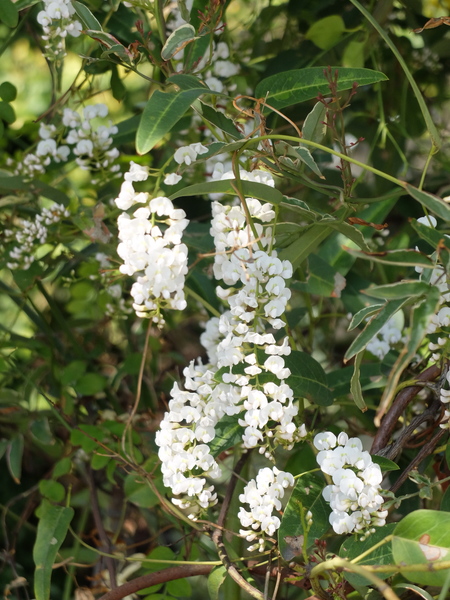
Hardenbergia (genus)
Japanese name: ハーデンベルギア
Scientific name: Hardenbergia
[Overview]
An evergreen woody climber.
The upper part of the stem becomes vine-like and twines around other objects.
The leaves are simple and alternate, slender, leathery, thick and entire.
Racemes arising from the leaf axils densely bear many flowers.
The flowers are butterfly-shaped (papilionaceous) with a rounded standard petal, and the colors include blue-purple, pink and white.
The fruit is a slender pod.
[Cultivation]
Propagate mainly by stem cuttings, but seed is also possible.
It tolerates winter temperatures down to about -3°C, but avoid frost and cold wind, which damage the plant.
In cold regions, grow it in a pot and bring it indoors.
It is not particular about soil as long as it is sunny and well drained.
Strong direct sun in midsummer and extreme dryness cause leaf scorch and damage the plant, so move potted plants to an airy place in partial shade.
Excess moisture causes root rot, so for potted plants take care not to let the soil become too wet; from spring to autumn water thoroughly when the soil surface dries, and keep it on the dry side in winter.
Watch for drying out from the time buds form until the flowers have finished blooming.
For plants in the ground, rainfall is sufficient.
Apply slow-release fertilizer once a month in spring and autumn, but be careful of the nutrient ratio, since fertilizer high in nitrogen produces only leaves and makes flowering difficult.
Although it is a climber, it can be handled like a shrub if pruned.
Avoid pruning after autumn, when flower buds form.
There are no particular pests or diseases.
Details
Translated from our Japanese encyclopedia. If anything differs, the Japanese page is correct.