
Plant Encyclopedia

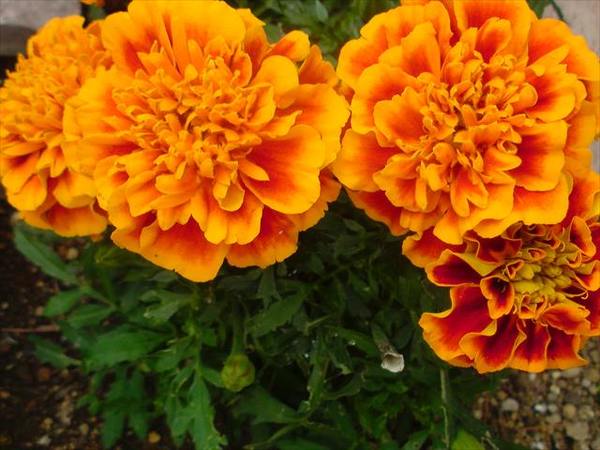
Tagetes patula (French marigold)
Japanese name: フレンチマリゴールド
Scientific name: Tagetes patula
[Overview]
An annual 30–50 cm tall.
The leaves and involucre have oil glands and a distinctive strong smell.
It branches well, and the plant spreads somewhat sideways.
The leaves are alternate, deeply pinnately divided, with serrated margins.
Capitula 3–6 cm across are borne at the stem tips; flower forms include single, double, and crested types in which the tubular florets are raised, and flower colors include yellow, orange, red and bicolor.
The fruit is an achene.
[History]
It arrived in Japan in the first half of the Edo period.
[Uses]
The flowers and leaves are used medicinally.
The flowers are dried and used like a spice, and are also used as a dye and as feed to deepen the yellow of egg yolks.
An essential oil called tagetes oil can also be obtained.
Because it is effective in controlling nematodes, it is also used as a companion plant when growing vegetables.
[Cultivation]
Propagate from seed or by stem cuttings.
It grows well in any soil as long as the site is sunny and well drained.
For potted plants, water thoroughly when the soil surface dries; for plants in the ground, rainfall is sufficient unless summer brings a long spell of sunny weather and the soil becomes severely dry.
Too much fertilizer produces only leaves and makes flowering difficult, so unless the soil is very poor, base fertilizer alone is enough.
Spider mites can occur.
[Notes]
The name French marigold comes from the fact that it spread via France when it was introduced to Europe.
Details
Japanese: フレンチマリゴールド、コウオウソウ(紅黄草)、マリーゴールド、クジャクソウ(孔雀草)、マンジュギク(万寿菊)
Translated from our Japanese encyclopedia. If anything differs, the Japanese page is correct.