
Plant Encyclopedia

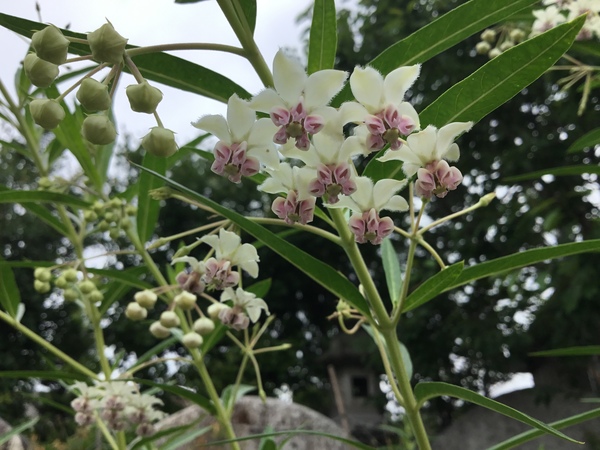
Gomphocarpus physocarpus (balloonplant, "Fusentowata")
Japanese name: フウセントウワタ (風船唐綿)
Scientific name: Gomphocarpus physocarpus
[Overview]
A subshrub 1–2 m tall.
It is not cold-hardy, so in Japan it is treated as an annual except in warm regions.
Damaging the stems or leaves produces a white milky sap.
The stem branches freely.
Leaves are simple and opposite, lanceolate to oblanceolate, about 10 cm long and 1.2 cm wide.
Umbels arise from the leaf axils in the upper part of the stem.
The flowers are white; the corolla is 5-lobed and the corona is pale purple.
The fruit is a follicle that swells like a balloon, with a pointed tip and many small projections.
The seeds have a pappus.
[Cultivation]
Propagate from seed or cuttings.
For cuttings, immediately wash the cut end with water or soak it in water to rinse off the milky white sap, then let the cut end dry before inserting it.
In areas without frost it can overwinter.
It prefers fertile soil that is sunny and well drained.
Poor drainage causes root rot.
It becomes a large plant, so secure a certain amount of space.
Water thoroughly when the soil surface dries.
Too much fertilizer reduces flowering or causes overgrowth, so use only base fertilizer for plants in the ground, and for potted plants give only liquid fertilizer from after flowering until autumn.
There are no particular pests or diseases.
Details
Japanese: フウセントウワタ(風船唐綿)、フウセンダマノキ(風船玉木)
Translated from our Japanese encyclopedia. If anything differs, the Japanese page is correct.