
Plant Encyclopedia

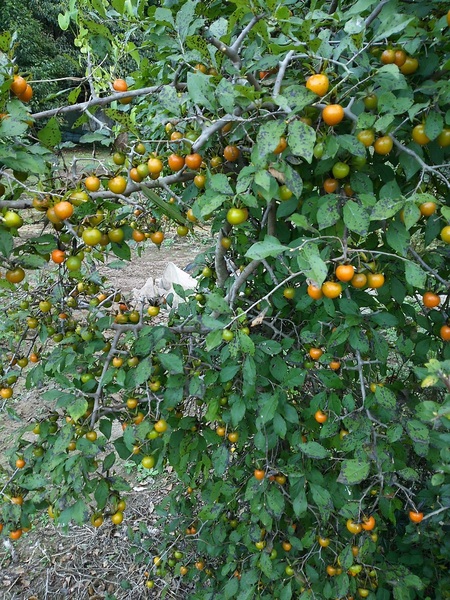
Diospyros rhombifolia (princess persimmon, "Tsukubanegaki")
Japanese name: ツクバネガキ (衝羽根柿)
Scientific name: Diospyros rhombifolia
[Overview]
A deciduous shrub to small tree up to 8 m tall, found in its native range in forests and on slopes along rivers at elevations of 300–800 m.
The branches are covered with inconspicuous thorns and are hairy.
The leaves are simple and alternate, rounded rhombic, 4–8.5 cm long and 1.8–3.8 cm wide, and thinly leathery.
The upper surface of the leaves is glossy.
The petiole is 2–4 mm.
It is dioecious.
The male flowers are 4 mm long and pale yellow; the corolla is urn-shaped with 4 recurved lobes at the tip, and there are 16 stamens and 1 degenerate ovary.
The female flowers are about 5 mm long and white; the corolla is urn-shaped with 4 recurved lobes at the tip, and there are 6 degenerate stamens.
The fruit is an elliptical, pointed berry 2 cm across that ripens to orange.
The fruit stalk is long, and the fruits hang downward.
The calyx is greatly developed and recurved.
The flesh is astringent and not suited to eating.
The seeds are oblong, 1 cm long, and number 2–4.
[History]
It is said to have been brought back from China around 1940 by Akio Kikuchi, the first director of the Kyoto Prefectural Botanical Garden.
[Cultivation]
Propagate from seed or by grafting.
Sow the seeds immediately after harvesting.
As long as the site is sunny, it is not particular about soil.
For potted plants, water thoroughly from spring to autumn when the soil surface dries, and keep on the dry side in winter.
For plants in the ground, rainfall is sufficient.
Apply slow-release fertilizer placed on the soil once a month from spring to autumn.
To obtain fruit, prepare both male and female plants and pollinate by hand.
There are no particular pests or diseases.
Details
Japanese: ツクバネガキ(衝羽根柿)、ロウアガキ(老鴉柿)、ロウヤガキ、ヒメガキ(姫柿)
Translated from our Japanese encyclopedia. If anything differs, the Japanese page is correct.