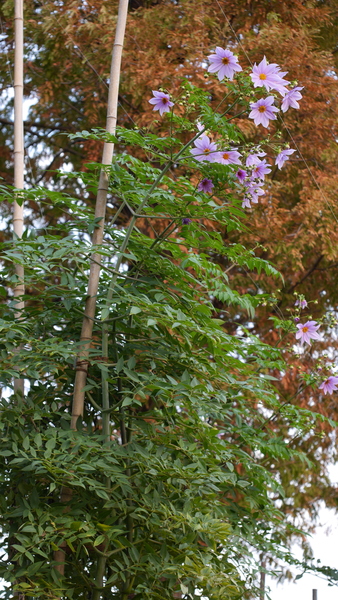
Japanese name: コダチダリア Scientific name:Dahlia imperialis
[Overview]
A fast-growing perennial or subshrub reaching 6–9 m in height.
It has tuberous roots underground.
The stem is erect and thick, with bamboo-like nodes, and somewhat six-ridged.
The leaves are opposite, 2–3 times pinnately compound, and as much as 60–90 cm long including the leaf stalk.
The stems, which are usually sturdy and branching, bear dozens of flowers.
The number of flowers can exceed 300.
The flowers are flower heads up to 15 cm across, and the ray florets around the edge are white, wisteria, purplish pink and so on.
The tubular florets in the center of the head are yellow, but sometimes the tips are tinged with red.
[Cultivation]
Propagate from seed, by division, or by cuttings.
It prefers a sunny, well-drained place rich in organic matter.
It is a short-day plant that blooms as the days shorten, so it is hard to get it to flower in places that stay bright at night, such as near street lights.
When planted in the garden, it needs no special care, but it falls over easily, so a support is necessary.
Cutting it back adjusts its height.
Armyworms can occur.