
Plant Encyclopedia

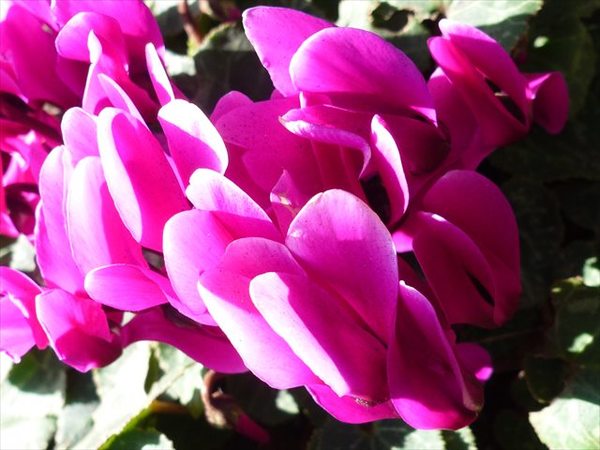
Cyclamen persicum
Japanese name: シクラメン
Scientific name: Cyclamen persicum
[Overview]
When simply "cyclamen" is mentioned, it almost always refers to Cyclamen persicum and its garden varieties, so this species is described here.
A perennial.
It has a slightly flattened, spherical tuber.
The leaves are simple and basal, usually heart-shaped, with silvery-white markings on the upper surface.
The leaf margins are toothed.
A single flower is borne facing downward at the tip of a long flower stalk; the corolla is 5-lobed and curves back upward.
Flower colors vary from white to red, and the base of the corolla is usually purple.
The flowers are originally fragrant, but this has been lost in many garden varieties.
Once fertilized, the flower stalk bends downward.
[History]
It is said to have begun when the East India Company introduced it from Cyprus to England in 1731.
[Cultivation]
Give it plenty of sunlight when it is in flower.
It dislikes direct summer sun and hot, humid conditions.
Water thoroughly when the soil surface dries, but pour gently around the edge of the pot, because water on the leaves and flowers damages them.
It is weak in summer heat, so generally the leaves die back in early summer and it enters dormancy.
During dormancy, keep it in a shady, well-ventilated place without watering until the leaves emerge.
If it does not go dormant in a cool region, keep it in partial shade and continue watering through summer.
As the leaves grow larger, sunlight may not reach the buds under the leaves and they may wither.
It is good to arrange the position of the leaves so that sunlight reaches the base of the plant and more of the leaves.
In winter, it is good to place it by a sunny window out of the drafts of heating.
Take care to protect it from freezing.
When flowers and leaves wither, promptly pluck them off at the base.
Pests and diseases include gray mold, soft rot, fusarium wilt, cyclamen mites, aphids and thrips.
[Notes]
The alternative name Buta-no-manju comes from the shape of the tuber, and Kagaribi-bana from the shape of the flower.
Details
Translated from our Japanese encyclopedia. If anything differs, the Japanese page is correct.