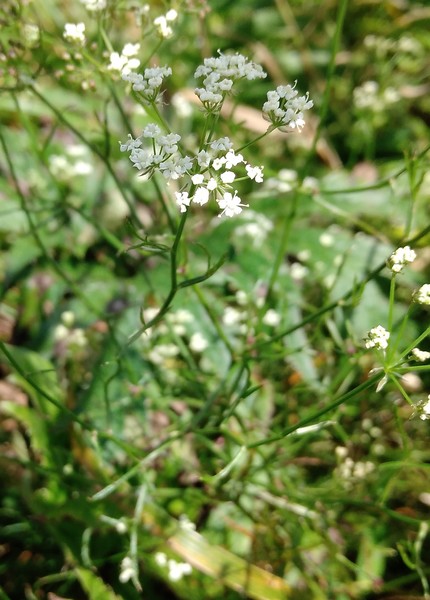
Japanese name: ムカゴニンジン(零余子人参) Scientific name:Sium ninsi
[Overview]
A perennial 0.3–1 m tall, growing in water in sunny wetlands, pond and marsh edges, fallow rice fields, and waterways.
Several thick white roots emerge in a bundle.
The leaves are alternate, odd-pinnately compound on the lower part of the stem and ternately compound on the upper part; the leaflets are round to linear, 1–8 cm long and 0.2–1 cm wide, and toothed.
The base of the petiole forms a sheath that clasps the stem.
In autumn, bulbils form at the base of the plant and in the leaf axils, so it also reproduces by means other than seed.
The flowers are small, white and 5-petaled, borne in compound umbels, with the petal tips curving inward.
The fruit is a spherical mericarp with a pentagonal cross section, with about 11 oil ducts, which are also present under the ridges.