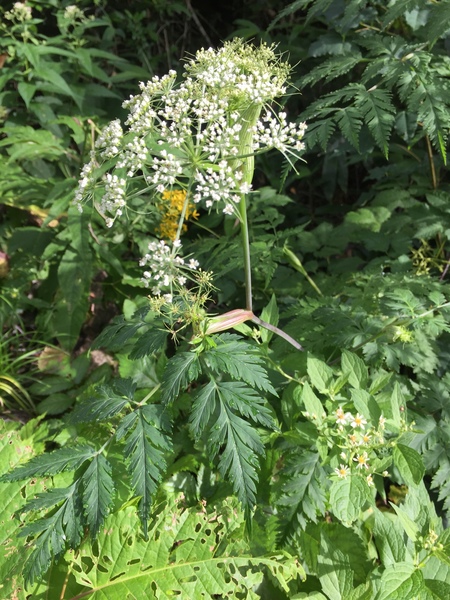
Japanese name: ミヤマセンキュウ(深山川芎) Scientific name:Conioselinum filicinum
[Overview]
A perennial 40–80 cm tall, found in grasslands from the mountains to the subalpine zone.
The stem is hollow and erect, and branches in the upper part.
The basal leaves are 2–3 times ternately pinnately compound; the leaflets are further deeply divided and thin, and the tips of the lobes extend into tail-like points.
The stem leaves are alternate, and the base of the petiole swells into a sheath.
The flowers are small, white and 5-petaled, borne in large numbers in compound umbels 6–10 cm across.
The calyx teeth are inconspicuous.
The inflorescence has involucral bracts and bractlets, and the bractlets are numerous and conspicuous.
The fruit is a schizocarp.
[Cultivation]
Propagate from seed.
It is suited to cool regions.
It prefers a sunny, well-drained site.
In summer, keep it cool in partial shade.
For potted plants, water thoroughly when the soil surface dries; for plants in the ground, rainfall is sufficient.
Apply slow-release fertilizer in spring and autumn.
There are no particular pests or diseases.