
Plant Encyclopedia

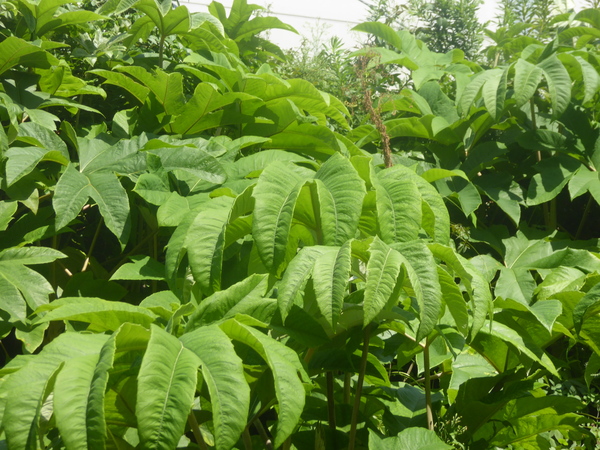
Tetrapanax papyrifer (rice-paper plant, "Kamiyatsude")
Japanese name: カミヤツデ (紙八手)
Scientific name: Tetrapanax papyrifer
[Overview]
An evergreen shrub 3–5 m tall with a trunk diameter of 10 cm.
In Japan, it often loses its leaves in winter or its aboveground parts die back.
The trunk has no spines, and the pith is thick and white.
Young trunks are densely covered with pale brown stellate hairs.
The leaves are simple and alternate, clustered at the top of the trunk, and palmate, 30–75 cm across.
The palmate leaf is cleft to the middle into 7–12 segments, and the tips of the segments are split in a notch shape like the nock of an arrow.
The leaves are thin, densely covered with white hairs on the underside, and have coarse serrations along the margins.
The leaf stalk is 20–50 cm long and densely covered with pale brown hairs.
At the branch tips it produces an inflorescence about 50 cm long, made up of spherical umbels gathered in a panicle, bearing many small yellowish-white 4-petaled flowers.
The inflorescence is at first densely covered with brown hairs.
The fruit is spherical, 4 mm across, and ripens blackish purple.
[Uses]
The pith of trunks in their third to fourth year is used for cork, artificial flower material, packaging material, paper and more.
It is also used as a folk remedy.
[Cultivation]
Propagate from seed, by cuttings, or by layering.
It is a plant suited to warm regions, and suitable areas for cultivation are Kanto and south.
In areas with frost, it loses its leaves or the aboveground parts die back in winter, but if the roots do not freeze, it sprouts again the following spring.
It prefers sunny, well-drained, moist places.
It grows quickly.
Details
Japanese: カミヤツデ(紙八手)、ツウダツボク(通脱木)、ツウソウ(通草)
Translated from our Japanese encyclopedia. If anything differs, the Japanese page is correct.