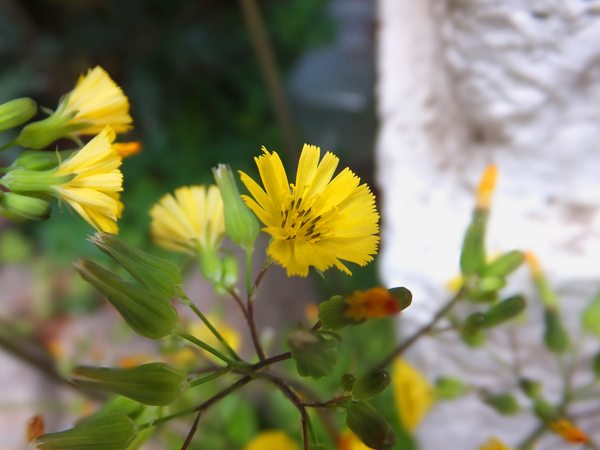
Japanese name: オニタビラコ(鬼田平子) Scientific name:Youngia japonica
[Overview]
A biennial 20–100 cm tall, found in sunny places such as roadsides and fields.
White milky sap comes out when the stem or leaves are damaged.
The whole plant is covered with soft white hairs.
Several stems are produced.
There are basal leaves and stem leaves.
The basal leaves form numerous rosettes, are 8–25 cm long and 1.7–6 cm wide, and are pinnately divided.
There are several stem leaves, which are alternate and become smaller toward the top.
The yellow flower heads are borne in compound corymbs at the stem tips.
The flower heads are 7–8 mm across and consist only of ray flowers.
In the north the flowering season is May–October, but in warm regions it can be seen blooming all year round.
The fruit is an achene with a white pappus.