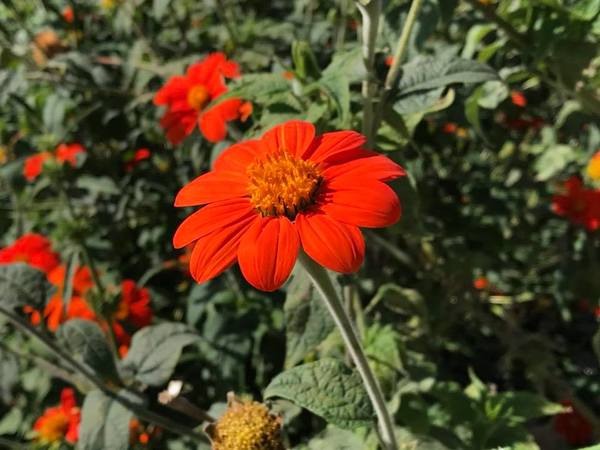
Japanese name: メキシコヒマワリ Scientific name:Tithonia rotundifolia
[Overview]
A perennial 1–2 m tall, but because it is not cold-hardy it is treated as an annual in Japan.
The stem is erect and much branched, and the base becomes woody.
The leaves are alternate, ovate to triangular-ovate, 3–12 cm long, and are simple leaves that are either 3-lobed or unlobed.
Three veins are conspicuous on the leaf, and the leaf margin is toothed.
The leaf stalk is about 10 cm long.
The stem tips bear orange-red flower heads 7.5 cm across.
The fruit is an achene.
[Cultivation]
Propagate from seed.
It dislikes transplanting, so sow directly where it is to grow, or sow in plastic pots and then plant out.
It prefers a sunny, well-drained site.
Rainfall is sufficient unless summer brings a long spell of sunny weather and the soil becomes dry.
It is best fertilized sparingly; too much makes it leggy, and especially with a lot of nitrogen it produces only leaves and flowers poorly.
There are no particular pests or diseases.