
Plant Encyclopedia

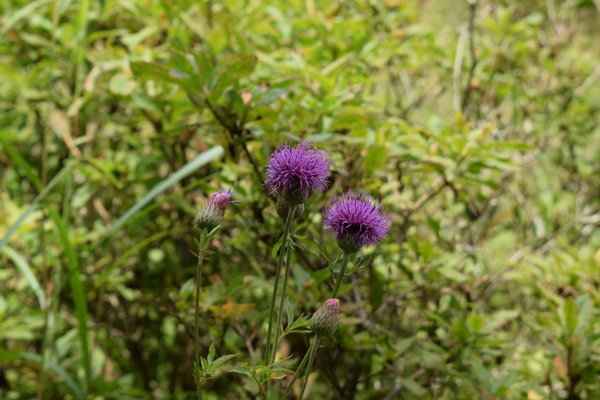
Serratula coronata subsp. insularis ("Tamuraso")
Japanese name: タムラソウ (田村草)
Scientific name: Serratula coronata subsp. insularis
[Overview]
A perennial 30–140 cm tall, found in mountain grasslands.
The stem is erect, branches well in the upper part, and has conspicuous vertical ridges.
There are both basal leaves and stem leaves, and the basal leaves remain at flowering time.
The leaves on the stem are alternate.
The basal leaves and the leaves on the lower part of the stem are pinnately divided into 4–7 lobes, have fine hairs on both surfaces, and the teeth do not become sharp spines.
The petiole is 11–30 cm long.
A single reddish-purple flower head 3–4 cm across is borne at the tip of the stem or branch.
The involucral bracts have 7–8 lobes.
The fruit is an achene with pappus.
[Cultivation]
Propagate mainly from seed, but division is also possible.
It prefers a sunny, well-ventilated site with well-drained soil.
Strong direct sun in midsummer can scorch the leaves, so in that case provide about 50% shade during summer or move it to partial shade.
Take care not to let it become too wet; for potted plants, water thoroughly when the soil surface dries, and for plants in the ground, rainfall is sufficient unless summer brings a long spell of sunny weather and the soil becomes severely dry.
Little fertilizer is needed; for potted plants, place slow-release fertilizer on the soil in spring and autumn, and for plants in the ground none is particularly necessary.
Pests and diseases include powdery mildew and aphids.
Details
Translated from our Japanese encyclopedia. If anything differs, the Japanese page is correct.