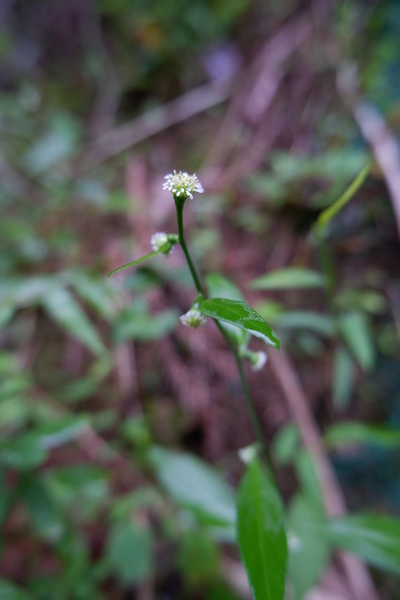
Japanese name: シュウブンソウ(秋分草) Scientific name:Rhynchospermum verticillatum
[Overview]
A perennial 50–100 cm tall, found in forests in the mountains.
It has long creeping underground stems.
The stem is erect, and 2–4 long lateral branches spread out from the point where the main stem stops growing.
The leaves are of two kinds, basal leaves and stem leaves; the basal leaves and the leaves on the lower part of the stem have withered by the time of flowering.
The leaves on the stem are simple and alternate, obovate-elliptic to lanceolate, 7–15 cm long and 2–3 cm wide, with pointed tips, and both surfaces are rough with stiff short hairs.
The leaf margins have sparse teeth.
The flower heads are small, about 0.5 cm across, pale yellowish green, and face downward at the ends of short stalks emerging from the leaf axils.
The flower heads consist of disc florets and ray florets; the ray florets are white, 10–40 in number, and arranged in 2–3 rows.
The involucre is broadly bell-shaped, and the involucral bracts are in 3 rows.
The achenes are hairless with glandular dots, and usually have no pappus.
Only the achenes of the ray florets have a distinct beak.
[Notes]
The Japanese name comes from the fact that it flowers around the autumn equinox.