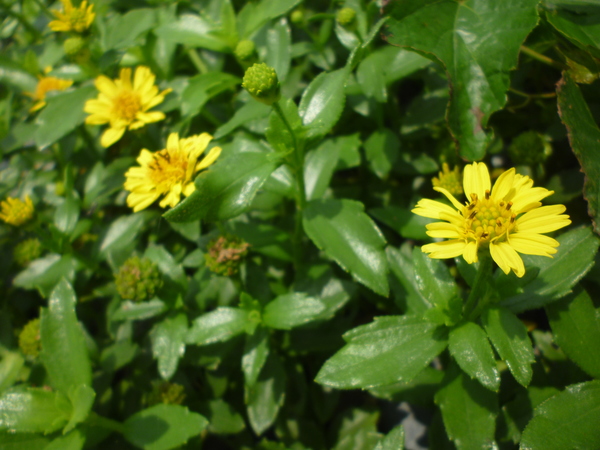
Japanese name: ネコノシタ(猫舌) Scientific name:Melanthera prostrata
[Overview]
A perennial found on sandy coastal beaches.
The stems are long and creeping, rooting at the nodes.
The leaves are simple and opposite, oblong to lanceolate, 1.5–4.5 cm long and 0.5–1.5 cm wide, thick, and rough on the surface because of stiff hairs.
The leaf margin has a few low teeth.
A single flower head about 1.5–2 cm across is borne at the tip of the flower stalk.
Both the ray florets and the tubular florets are yellow.
The fruit is an achene and is dispersed by ocean currents.
[Cultivation]
Propagate by cuttings.
It prefers a sunny, well-drained place and suits sandy, somewhat lean soil.
It tolerates partial shade, but with poor sunlight it becomes leggy and flowers poorly.
It is best kept somewhat on the dry side; take care to avoid excess moisture. For potted plants, water thoroughly when the soil surface dries from spring to autumn, and keep on the dry side in winter.
For plants in the ground, rainfall is sufficient.
Little fertilizer is needed; for potted plants, place slow-release chemical fertilizer on the soil in spring and autumn, and for plants in the ground none is particularly needed.
There are no particular pests or diseases.
[Notes]
The Japanese name compares the rough leaves to a cat's tongue.