
Plant Encyclopedia

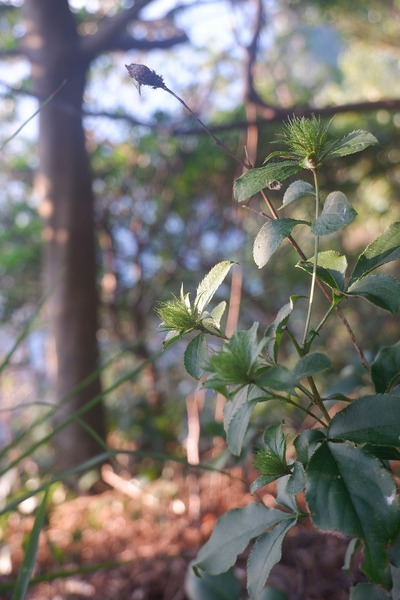
Atractylodes ovata (ovate-leaf atractylodes, "Okera")
Japanese name: オケラ (朮)
Scientific name: Atractylodes ovata
[Overview]
A perennial 0.3–1 m tall, found in slightly dry grassland and light deciduous woods in the mountains.
It has a thick, short, creeping rhizome that is knobbly with nodes.
The young stems and leaves are densely covered with white hairs.
The stem is erect, hard, and branches in the upper part.
There are basal leaves and leaves on the stem; the basal leaves have withered by the flowering season.
The stem leaves are alternate; those on the lower part of the stem are 8–11 cm long and deeply pinnately divided into 3–5 lobes, while some leaves on the upper part of the stem are simple and obovate.
The leaf margin has teeth with spiny tips.
The leaves have petioles.
The plant is dioecious.
Flower heads 2–2.5 cm across are borne at the stem tips.
The flower heads consist only of tubular florets that are white to pale reddish purple.
The involucre is bell-shaped, and the involucral bracts are in 7–8 rows.
At the base of the flower head there are two rows of conspicuous bracts, fully pinnately divided into a fishbone-like shape.
The fruit is an achene with a feathery pappus.
[History]
It appears in the Man'yoshu under the name ukera.
[Uses]
The spring shoots are used as a wild vegetable.
The rhizome is used medicinally and is also included in tososan (otoso, the spiced medicinal sake drunk at New Year).
[Cultivation]
Propagate from seed or by division.
It prefers a sunny, well-drained, well-ventilated site.
For potted plants, water thoroughly when the soil surface dries; for plants in the ground, rainfall is sufficient unless summer brings a long spell of sunny weather and the soil dries out.
In spring and autumn, place slow-release fertilizer on the soil.
There are no particular pests or diseases.
[Notes]
At Yasaka Shrine in Kyoto, the rhizome is burned at the Okera Festival held at the turn of the year.
Details
Japanese: オケラ(朮)、うけら(宇家良)
Translated from our Japanese encyclopedia. If anything differs, the Japanese page is correct.