
Plant Encyclopedia

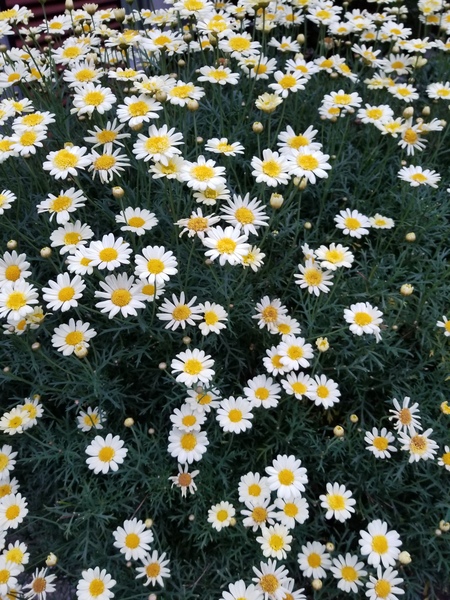
Argyranthemum frutescens (Paris daisy, "Mokushungiku")
Japanese name: モクシュンギク (木春菊)
Scientific name: Argyranthemum frutescens
[Overview]
A perennial 60–100 cm tall, growing on seashores in its native range.
The base of the stem becomes woody, and the whole plant is hairless.
The leaves are alternate and deeply pinnately cut.
The flower heads are borne singly in the leaf axils and are about 5 cm across.
The ray florets around the edge of the flower head are white, and the central tubular florets are yellow.
The fruit is an achene.
[History]
It arrived in Europe in 1699; in Japan it was recorded in the Nihon Shokubutsu Meii in 1884, and a cultivar called 'Zairai-shiro' was introduced in the Meiji era.
What is generally sold as marguerite includes, besides Mokushungiku, garden cultivars produced by crossing Mokushungiku with closely related species such as Shungiku and Hanawagiku.
[Cultivation]
Propagate from seed or by stem-tip cuttings.
It has weak cold tolerance and also dislikes summer heat and humidity.
It can overwinter outdoors in areas without frost.
It prefers well-drained, fertile soil and dislikes acidic soil.
For potted plants, keep them indoors in a sunny place from winter to spring, and outdoors in full sun from early summer to autumn; from the rainy season through midsummer, it is best to place them in airy partial shade out of the rain.
When planting in the ground, choose a sunny place not exposed to cold winter winds, and protect it in winter with a straw mulch or a vinyl greenhouse.
Water sparingly in midsummer, and in other seasons water when the soil surface dries.
In addition to a base fertilizer, apply slow-release fertilizer once each in spring and autumn.
Pests and diseases include fusarium wilt, damping-off, aphids and cutworms.
Growing it repeatedly in the same place makes damping-off more likely.
Details
Japanese: モクシュンギク(木春菊)、マーガレット、キダチカミルレ
Translated from our Japanese encyclopedia. If anything differs, the Japanese page is correct.