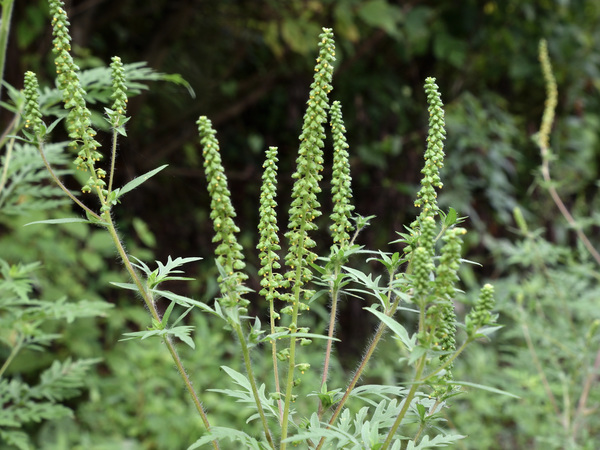
Japanese name: ブタクサ(豚草) Scientific name:Ambrosia artemisiifolia
[Overview]
An annual 30–120 cm tall, growing in colonies on somewhat dry vacant lots and riverbeds.
The stem is erect and branched, with soft hairs.
The leaves are opposite on the lower part of the stem and alternate on the upper part.
They are triangular-ovate, 6–12 cm long, deeply cut twice in a pinnate manner, and have appressed hairs.
The leaves on the lower part of the stem have long leaf stalks.
There are male and female flowers, both forming flower heads.
The male flower heads are yellow, 0.2–0.3 cm across, and many bloom hanging downward in spike-like inflorescences at the stem tips.
The female flower heads grow 2–3 in the leaf axils at the base of the male inflorescence.
The fruit is an achene enclosed in the involucre.
[History]
It was confirmed in the Kanto region in the Meiji period and spread to various places from the Showa period onward.
[Notes]
It is designated as an invasive alien species requiring caution.
It is also a plant that causes hay fever.