
Plant Encyclopedia

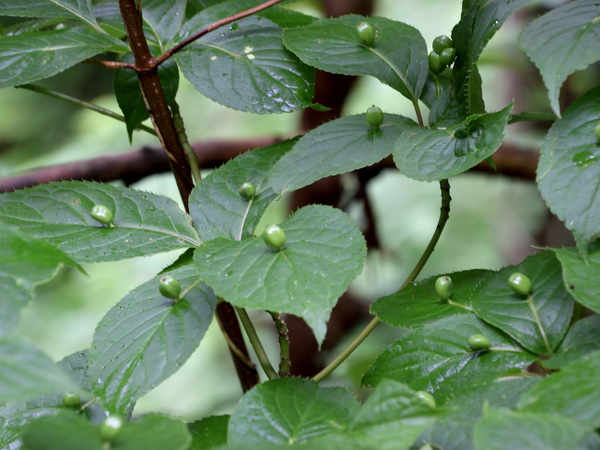
Helwingia japonica subsp. japonica var. japonica ("Hanaikada")
Japanese name: ハナイカダ (花筏)
Scientific name: Helwingia japonica subsp. japonica var. japonica
[Overview]
A deciduous shrub up to 3 m tall, found in forests in the mountains.
It branches well, and young branches are green or purplish brown.
Leaves are simple and alternate, elliptic to ovate, 4–13 cm long and 1.5–7 cm wide, with an awn-like pointed tip.
4–6 pairs of lateral veins are raised on the underside.
The leaf margins have awn-like pointed teeth.
The petiole is 1–5 cm long.
It is dioecious.
Both male and female flowers are 0.4–0.6 cm across, pale green with 3–4 petals, and borne at the center of the leaf.
Male flowers are borne in clusters of 1–20.
Female flowers are usually borne singly, but sometimes in twos or threes.
The fruit is a spherical berry 0.7–1.1 cm across, ripening to black.
[Uses]
The young shoots are eaten as a wild vegetable, and the leaves and roots are used medicinally.
[Cultivation]
Propagate from seed.
Sow the seeds immediately after collecting them.
It prefers partial shade to shade and fertile soil that is well drained, retains water well, and is moderately moist.
Avoid strong direct sunlight and dry cold winds.
Take care that it does not dry out; for potted plants, water thoroughly when the soil surface dries, and for plants in the ground, rainfall is sufficient unless summer is dry.
As fertilizer in winter, dig holes around the plant and apply organic fertilizer such as compost.
There are no particular pests or diseases.
[Notes]
The Japanese name compares the way the flowers are borne at the center of the leaf to a raft.
Details
Translated from our Japanese encyclopedia. If anything differs, the Japanese page is correct.