
Plant Encyclopedia

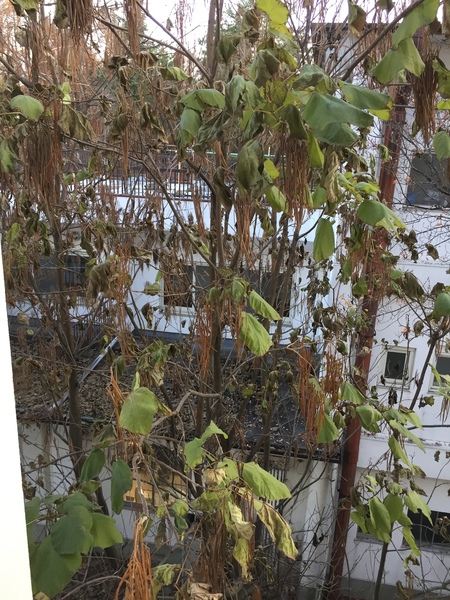
Catalpa ovata (yellow catalpa, "Kisasage")
Japanese name: キササゲ (木豇豆)
Scientific name: Catalpa ovata
[Overview]
A deciduous tree about 10 m tall, sometimes seen naturalized.
Young branches have glandular hairs, but later become hairless.
Leaves are simple and opposite, broadly ovate, 10–25 cm long and 7–20 cm wide, and often shallowly 3-lobed.
The petiole is 5–20 cm long, with glandular hairs at first but later hairless.
Panicles at the branch tips bear many flowers.
The flowers are tubular, 2–3 cm long, with a shallowly 5-lobed tip, and are two-lipped.
The flower color is yellowish white, with dark purple markings on the inside.
The fruit is a slender capsule 30–40 cm long and 0.5 cm wide, which hangs down.
The seeds are flat and oblong, 1 cm long, with long hairs densely growing at both ends.
[Uses]
The fruit is used medicinally.
[Cultivation]
Propagate from seed and by cuttings.
It prefers sunny, fertile sites.
It dislikes windy places.
It is easy to grow.
Fertilizer is not particularly necessary, but if applied, use fertilizer in winter, in January–February.
Prune in winter, but since flowers form on the tips of shoots that grew the previous year, cutting back too far will prevent flowering.
There are no particular pests or diseases.
Details
Japanese: キササゲ(木豇豆)、カミナリササゲ、カワギリ、ヒサギ
Translated from our Japanese encyclopedia. If anything differs, the Japanese page is correct.