Phryma leptostachya subsp. asiatica f. oblongifolia
Phryma leptostachya subsp. asiatica f. oblongifolia("Nagabahaedokuso")
Japanese name: ナガバハエドクソウ(長葉蠅毒草) Scientific name:Phryma leptostachya subsp. asiatica f. oblongifolia
[Overview]
A perennial 30–70 cm tall, found in slightly shaded places in woods and at woodland edges near villages and in the mountains.
It has a short underground stem.
The stem is erect.
The stem is covered with short downward-pointing hairs.
The leaves are simple and opposite, tending to grow on the lower part of the stem, 4–15 cm long and 2–7 cm wide, long ovate to elliptic, with a wedge-shaped base.
The leaves at the base of the stem are elliptic.
The leaves are sparsely hairy; on the underside the veins are sparse and the fine veins are indistinct.
The leaf margin has coarse serrations.
The lower on the stem, the longer the petiole of the leaf.
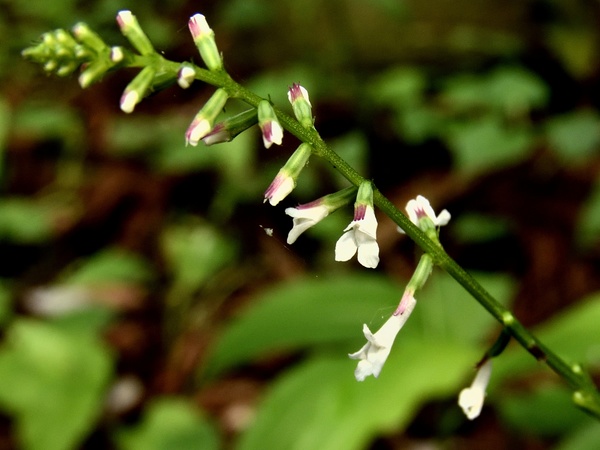
Slender spikes at the stem tip and in the leaf axils bear flowers sparsely.
The flowers are tubular, 0.5–0.8 cm long, with a two-lipped tip, and white, often tinged with pale pink.
The upper lip of the corolla is 2-lobed, and the width of the lobes does not narrow.
The flowers first face upward, then sideways when open, and downward at the fruiting stage.
The fruit is a capsule enclosed by the calyx and is carried by sticking to animals and clothing with the hooked projection at the tip of the calyx.