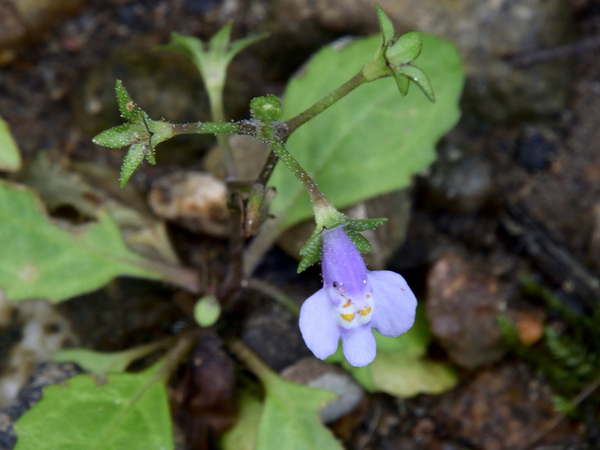
Japanese name: トキワハゼ(常磐黄櫨) Scientific name:Mazus pumilus
[Overview]
An annual 5–25 cm tall, seen along roadsides and in fields.
The leaves are clustered at the base, and several stems rise upright from among them.
It does not produce stolons.
The leaves are 1–3 cm long and 0.5–1.5 cm wide, obovate, with shallow serrations on the margin.
The basal leaves are opposite, large, and have petioles.
The leaves on the upper part of the stem are alternate, small, and have no petioles.
A raceme at the stem tip bears a few flowers sparsely.
The corolla is reddish purple and 1 cm long, opening at the tip into two lips; the upper lip is slightly 2-lobed and the lower lip is 3-lobed, with a raised center that is yellow with reddish brown markings.
The fruit is a flattened globose capsule enclosed by the calyx.
[Notes]
The Japanese name is said to come from tokiwa (evergreen), because it flowers throughout the year except winter, and haze (to burst), because the fruit bursts open.