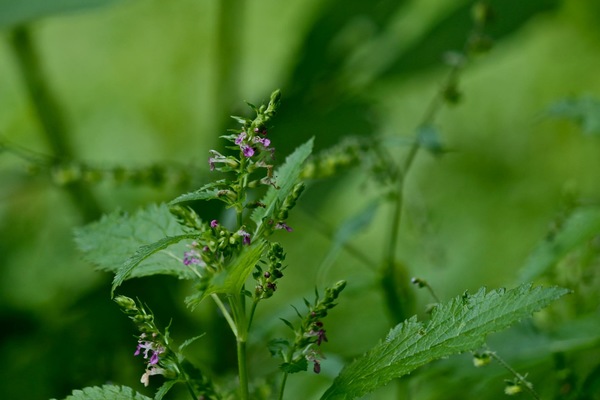
Japanese name: ニガクサ(苦草) Scientific name:Teucrium japonicum
[Overview]
A perennial 30–70 cm tall, found in grasslands and at forest edges in slightly moist places in hills and mountains.
The stem is sparsely covered with short downward-pointing hairs.
Leaves are simple and opposite, ovate-oblong to broadly lanceolate, 5–10 cm long and 2–4.5 cm wide, with pointed tips.
The leaf margins have sharp teeth.
At the stem tip it produces a compound cyme, forming a slender spike-like cluster 3–10 cm long.
The flowers are pale pink, two-lipped, and 1.2–1.5 cm long.
The upper lip is very small and deeply divided into 2 lobes.
The lower lip is 3-lobed, with a larger central lobe.
There are 4 stamens, which stick out far through the split in the upper lip together with the pistil.
The calyx is sparsely covered with short hairs, or is hairless apart from the calyx teeth.
The calyx teeth are erect and do not curve inward even when in fruit.
The fruit is a schizocarp.