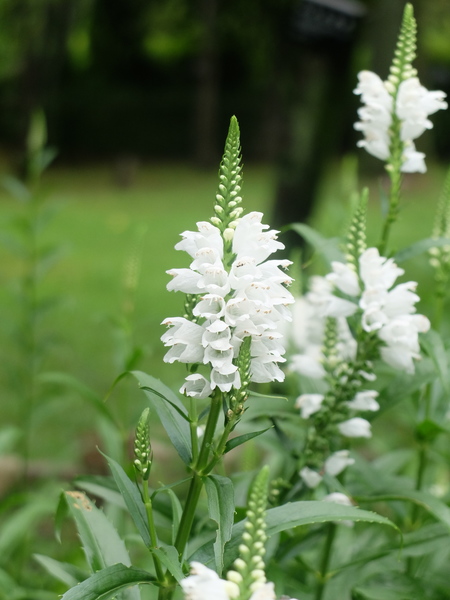
Japanese name: ハナトラノオ(花虎尾) Scientific name:Physostegia virginiana
[Overview]
A perennial 40–120 cm tall.
It spreads by sending out stolons.
The stem is erect with 4 ridges and square in cross section.
Leaves are simple and opposite, oblong to lanceolate, with toothed margins.
A raceme 10–30 cm long at the stem tip bears flowers that face all directions and are arranged regularly and densely.
The corolla is two-lipped, white or pale pink.
The fruit is a schizocarp.
[History]
It arrived in Japan in the Taisho era.
[Cultivation]
Propagate from seed, by division, or by stem cuttings.
It prefers sunny, well-drained, moderately moist, fertile soil.
Take care that it does not dry out; for potted plants, water thoroughly when the soil surface dries, and for plants in the ground as well, if sunny weather continues in summer and the soil becomes dry, water during the cool hours of morning and evening.
Too much fertilizer makes it leggy and prone to falling over, so apart from a base fertilizer, use it sparingly.
There are no particular pests or diseases.